Last updated: November 2026 | Author: Market Kapchur
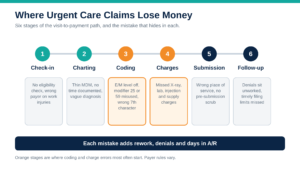
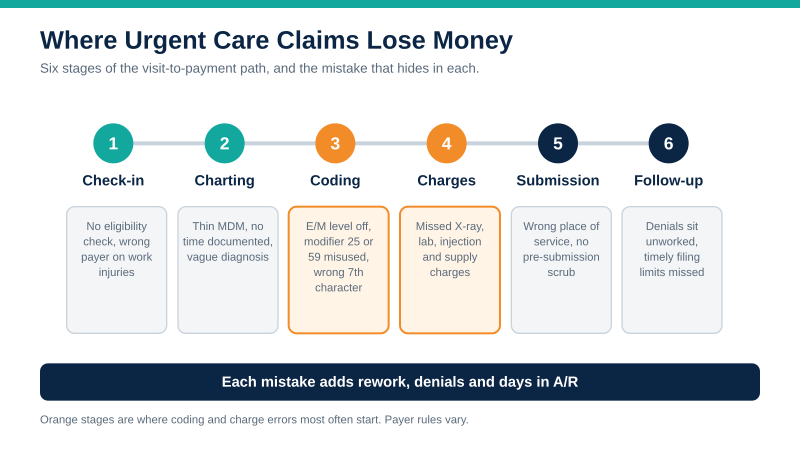
The most common urgent care billing mistakes are weak E/M documentation, misused modifiers, wrong place of service, missed procedure charges, thin diagnosis detail and slow denial follow-up. Each one adds rework and delays payment. Fixing them means documenting to the code, scrubbing claims before submission and working denials by root cause.
The Visit Took 20 Minutes. The Payment Is Taking 60 Days
A patient walks in with a laceration, gets an exam, an X-ray and sutures, and leaves in under an hour. Your team did everything right clinically. Then the claim bounces for a modifier, and the payment you expected in weeks turns into a rework queue.
That is how most urgent care billing mistakes work. They are small, repeated thousands of times, and invisible until A/R days climb. A practice that holds its denial rate under 3%, which is what MedVoice targets, got there by fixing these basics, not by luck.
This guide covers where urgent care billing and coding goes wrong, from E/M levels to modifiers to place of service, and how to fix each one. It is written for owners, office managers and billing leads at independent clinics.
| Key Takeaways Most urgent care billing mistakes start before the claim. Thin notes and missed charges cause denials that no biller can fully fix later. E/M coding is the biggest lever. Urgent care E/M coding rests on medical decision making or total time, and the note has to show it. Urgent care modifiers need documentation behind them. Modifier 25 and the X modifiers are scrutinized, so use them only when the record supports them. Payer rules vary. Urgent care billing and coding rules on place of service, after-hours codes and filing limits differ by payer and state, so check each contract. Catch errors early. A pre-submission scrub and weekly denial reviews cost far less than appeals. |
|---|
What Are the Most Common Urgent Care Billing Mistakes?
The most common urgent care billing mistakes are E/M levels that do not match the note, modifiers applied wrongly, missed ancillary charges, incorrect place of service, vague diagnoses and unworked denials. Most are preventable at the charge and coding stage, before a claim ever reaches a payer.
| Mistake | Why it slows payment | Fix |
|---|---|---|
| E/M level does not match the note | Downcoding loses revenue and upcoding invites audits | Code from MDM or total time, and document both |
| Modifier 25 or 59 misused | Edits deny the second service or the whole claim | Add modifiers only with supporting notes |
| Missed X-ray, lab or supply charges | Revenue is never billed | Reconcile orders, results and charges daily |
| Wrong place of service | Payer rejects or reprices the claim | Confirm POS 20 rules in each contract |
| Vague or incomplete diagnosis | Medical necessity fails | Capture specific ICD-10-CM codes and 7th characters |
| Denials left unworked | Filing windows close | Track by reason and appeal on a schedule |
How Does Urgent Care E/M Coding Go Wrong?
Urgent care E/M coding goes wrong when the level billed does not match what the note supports. Urgent care typically reports office or outpatient codes 99202 to 99205 and 99212 to 99215, chosen by medical decision making or total time on the date of the encounter. A thin note caps the level.
Since the 2021 office visit changes, history and exam are documented as medically appropriate but no longer drive the level. That helps busy clinics, but it moves pressure onto the assessment and plan.
- Copy-forward notes. Templates that carry old findings hide the real decision making and raise audit risk.
- No time statement. If you code by time, the total time and the activities counted must be in the record.
- Undercoding by habit. Defaulting to a low level on every visit leaves money on the table and still draws payer attention.
- Ignoring risk. Prescription management, imaging decisions and referral choices count toward MDM only when documented.
Many clinics fix urgent care E/M coding with short provider feedback sessions built on real denied or downcoded charts. MedVoice medical coding support and the free AI scribe and coding tool give coders suggestions for human review, so the provider stays in control of the final code.
Which Urgent Care Modifiers Cause the Most Denials?
Modifier 25 on the E/M and the 59 or X modifiers on procedures cause the most trouble. Modifier 25 signals a significant, separately identifiable visit beyond the procedure. CMS says to use a specific X modifier when one fits, and 59 only when none does. Neither belongs on a claim without notes to support it.
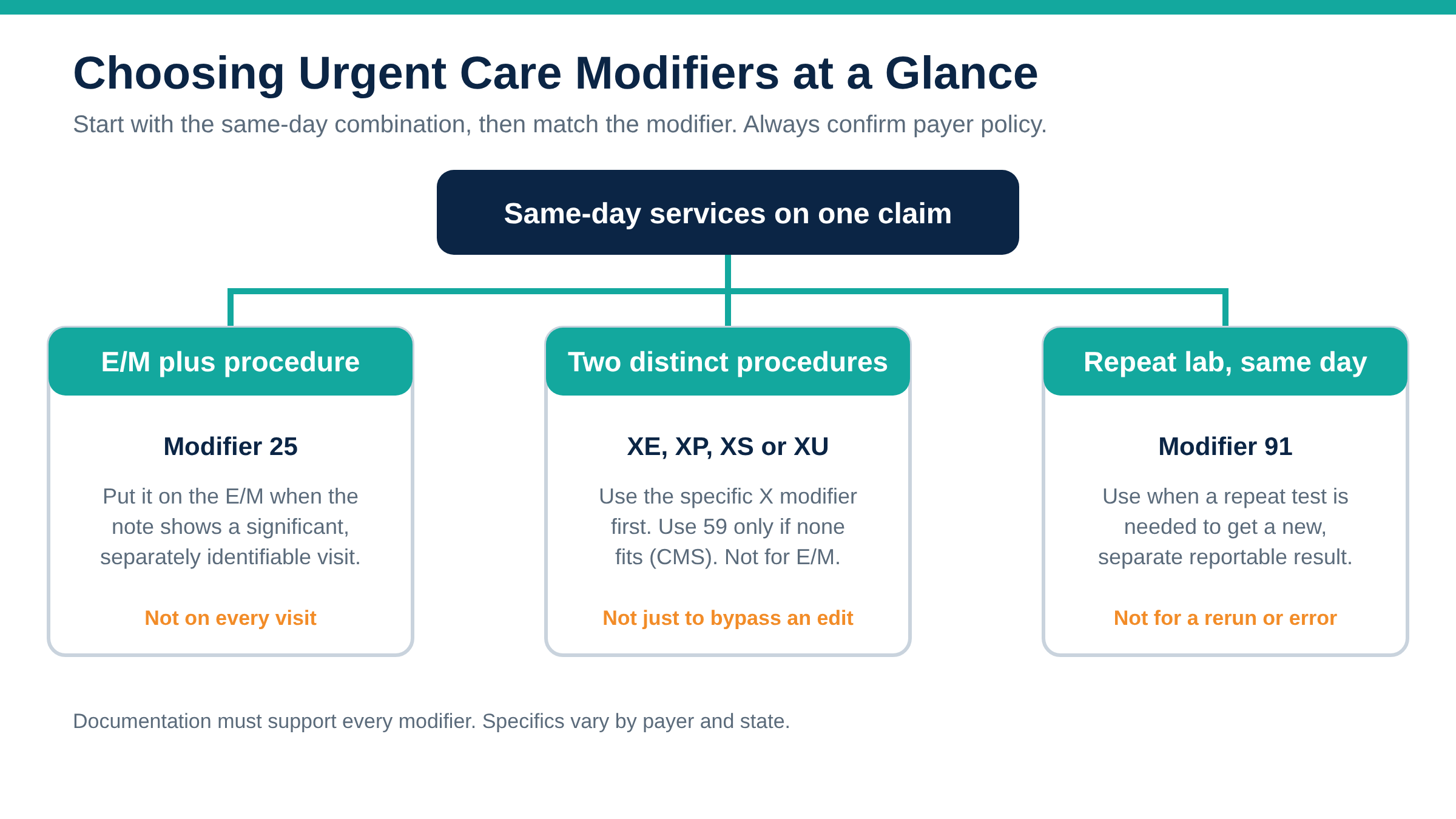
- Modifier 25 on every visit. Putting it on all E/M claims with a procedure is a pattern payers flag. Use it when the exam went beyond the usual pre-procedure work.
- Modifier 59 as a shortcut. CMS guidance says 59 is for cases where no more specific X modifier applies, and it is not used with E/M services.
- Modifier 91 on reruns. It fits a repeat test needed to get a new result, not a lab rerun after an error.
- Skipping the payer policy. Some commercial payers have their own edits for urgent care modifiers and telehealth modifier rules. These change often, so verify them.
If your team is unsure how a payer treats urgent care modifiers, a pre-submission scrub that checks code pairs against payer edits catches most problems before they become denials. See how MedVoice handles urgent care billing end to end.
Why Do Place of Service and After-Hours Codes Trigger Denials?
Place of service 20 identifies a freestanding urgent care facility, and clinic-based urgent care typically bills professional claims with POS 20. Hospital-based sites may bill differently. After-hours add-on codes are another trap, because some payers do not pay them or deny them at POS 20. Read each contract.
S9083, the global urgent care code, is informational for some payers and is not valid for Medicare. Codes such as 99050 and 99051 are also paid inconsistently. Billing them by habit, without checking, produces denials that look random but are really policy.
Front-end problems compound the issue. Wrong payer on a work injury, missed eligibility checks and registration typos all end in rejections. Our guide to prior authorization shows how front-end gaps become back-end delays.
What Documentation and Diagnosis Errors Hurt Urgent Care Claims?
Documentation and diagnosis errors hurt urgent care claims when the record does not support medical necessity or the ICD-10-CM code lacks detail. Injury codes need the right 7th character: A for active treatment, D for subsequent care and S for sequela. Unspecified diagnoses also invite payer edits.
- Wrong 7th character. A fracture seen first in urgent care is usually active treatment, so A applies, and D belongs to later routine healing visits.
- Unspecified codes. Laterality, site and cause detail matter, so capture them when the provider has them.
- Orders without results. An X-ray or lab billed with no report in the chart is an easy denial or recoupment.
- Missing signatures. Unsigned notes and orders weaken every code on the claim.
How Does Slow Follow-Up Turn Urgent Care Billing Mistakes Into Lost Cash?
Late claims and ignored denials turn fixable errors into write-offs. Medicare generally requires claims within 12 months of the date of service, and commercial payers set their own, often shorter, limits in the contract. Submit quickly, track every rejection and denial, and appeal while the window is open.
Urgent care volume is high and claim values are low, so teams tend to let small denials pile up. That is exactly how A/R ages. MedVoice clients see a 40% reduction in A/R days, and the driver is simple: denials get worked by reason, not by whoever has time. Our denial management team tracks root causes so the same error stops recurring.
Payment posting matters too. Underpayments and missed contract rates hide in remittances that nobody reconciles. See how payment posting catches them.
How Do You Fix Urgent Care Billing Mistakes for Good?
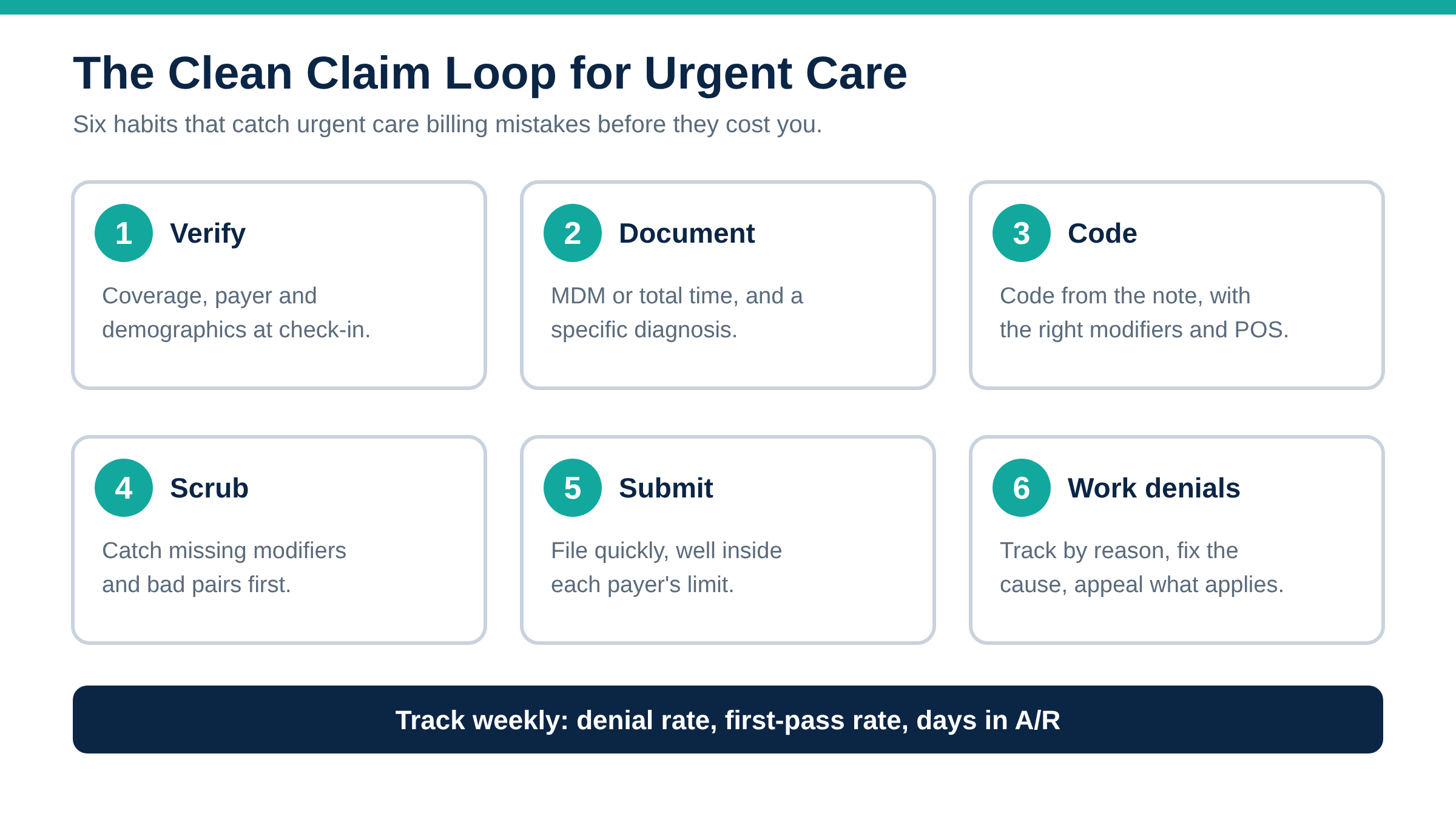
Fix urgent care billing mistakes with a repeatable loop: verify coverage at check-in, document to the code, code from the note, scrub before submission, file fast and work denials by root cause. Track denial rate, first-pass rate and days in A/R weekly so problems surface in days, not quarters.
- Audit a sample monthly. Review a small set of charts for urgent care billing and coding accuracy, covering E/M level, modifiers and charge capture.
- Use a claim scrubber. Pre-submission edits catch missing modifiers and bad code pairs. MedVoice reports a 98% clean claim submission rate with this approach.
- Standardize charge capture. One daily reconciliation of orders to charges prevents lost revenue.
- Compare vendors fairly. If you outsource, read how billing service pricing works before you sign.
Conclusion: Fix Urgent Care Billing Mistakes Before They Become Aged A/R
Urgent care billing mistakes are rarely dramatic. They are small, repeated errors in E/M levels, modifiers, place of service and follow-up. Document to the code, scrub claims before submission, verify payer rules and work denials by cause. Your clinic gets paid faster with less rework.
| Stop losing revenue to avoidable denials Request a free revenue audit or talk to MedVoice about your urgent care claims. We will review E/M coding, modifiers and denial patterns with you. Schedule a free consult Call 972-755-5474 | Toll free 855-215-5906 | sales@medvoiceinc.com |
|---|
Frequently Asked Questions
What are the most common urgent care billing mistakes?
Mismatched urgent care E/M coding levels are among the most common, followed by misused modifiers and missed charges. Level errors happen when notes do not support the code billed. Regular chart audits and provider feedback tend to fix them faster than any software change alone.
Do urgent care clinics use different E/M codes than primary care?
Urgent care generally reports the same office or outpatient E/M codes, 99202 to 99205 for new patients and 99212 to 99215 for established ones. Payer policy on patient status and after-hours add-ons can differ, so confirm requirements in each contract rather than assuming.
When should an urgent care clinic use modifier 25?
Use modifier 25 when a provider performs a significant, separately identifiable E/M service on the same day as a procedure, and the note shows work beyond the usual pre-procedure evaluation. Do not append urgent care modifiers automatically. Payers may review claims that carry it on every procedure visit.
How long do urgent care clinics have to file claims?
Medicare generally allows 12 months from the date of service. Commercial payers set their own limits in the contract, and many are shorter. Check each payer, file quickly and track rejected claims so a fixable error does not become a timely filing denial.
Should a small urgent care clinic outsource billing?
It can make sense when denials rise, A/R ages or staff spend too much time on rework. Look at transparency, HIPAA compliance, coding accuracy and reporting. A partner with urgent care billing and coding experience should explain modifiers, place of service and payer rules in plain terms.
.
Sources
- ACEP, Urgent Care E/M Coding FAQ. Office and outpatient E/M code use in urgent care.
- AAFP Family Practice Management, 2021 E/M Changes. Level selection by medical decision making or total time.
- CMS, MLN1783722: Proper Use of Modifiers 59, XE, XP, XS, XU (April 2026). Use X modifiers when one fits and 59 only if none does; not for E/M services.
- Experity, Coding E/M and Procedure Visits. Modifier 25 use on same-day E/M and procedures.
- CMS, Place of Service Code Set (HHS). POS 20 definition for urgent care facilities.
- Blue Cross and Blue Shield of Minnesota, Urgent Care and After-Hours Coding Policy. Professional versus institutional billing; S9083 and after-hours code handling.
- Moda Health, After-Hours and Special Circumstances Policy. Example of a payer denying after-hours codes at POS 20.
- AAPC, Initial, Subsequent and Sequela Encounters. ICD-10-CM 7th character A, D and S.
- CMS, Medicare Claims Processing Manual Timely Filing Update. Medicare 12-month filing limit from date of service.