Last updated: November 2026 | Author: Market Kapchur Organization
Medical record review for personal injury cases turns a pile of provider records into a source-cited timeline you can use. Expect treatment gaps, prior conditions, missing records and bill-to-chart mismatches flagged for your judgment, not legal or medical opinions. Agree on scope, format and review level before work starts.
The Records Arrived. Now Comes the Hard Part
Your client’s records finally landed. They came from the ER, a therapy clinic, an imaging center and two specialists, in different formats, out of order, with a few duplicates. The demand deadline has not moved.
This is where cases quietly get stronger or weaker. An adjuster will read every page looking for a gap in treatment or a prior complaint you did not see. That is why medical record review for personal injury cases belongs at the start of your workflow, not the end.
Here is what to expect from legal medical record review: what you get back, how the process works, what a good reviewer flags, and how to pick a partner. It is written for plaintiff and defense teams who need records they can rely on.
| Key Takeaways A legal medical record review is more than a summary. It checks completeness, consistency, causation support and damages documentation against your case questions. Expect flags, not opinions. Good reviewers point to gaps, prior history and conflicts with page citations, and leave legal and medical judgment to you and your experts. Scope drives quality. Share the incident date, body regions and goals up front. AI speeds the first pass, people validate it. AI output is a suggestion for human review. Choose medical record review services for law firms carefully. Check security, citations, clinical validation and pricing before you send a file. |
|---|
What Is Medical Record Review for Personal Injury Cases?
Medical record review for personal injury cases checks whether provider records match the client’s treatment timeline, injury claims and damages documentation. It confirms the record set is complete, consistent and organized, and flags what an insurer or opposing counsel may challenge. It informs your strategy and does not replace expert opinion.
It is broader than a chronology. A chronology sorts events by date. A review also asks what the records prove, what they leave out, and whether they hold together across providers. A solid review answers four questions:
- Is the record set complete? Look for missing pages, partial productions and referenced reports that never arrived.
- Do the records support causation? Check the mechanism of injury, first complaints and how diagnoses progress.
- Are gaps and prior conditions explained? Unexplained breaks and earlier complaints are what insurers go after.
- Are damages and future care documented? Treatment, bills and recommendations should line up.
What Should Attorneys Expect From Legal Medical Record Review?
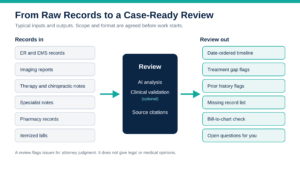
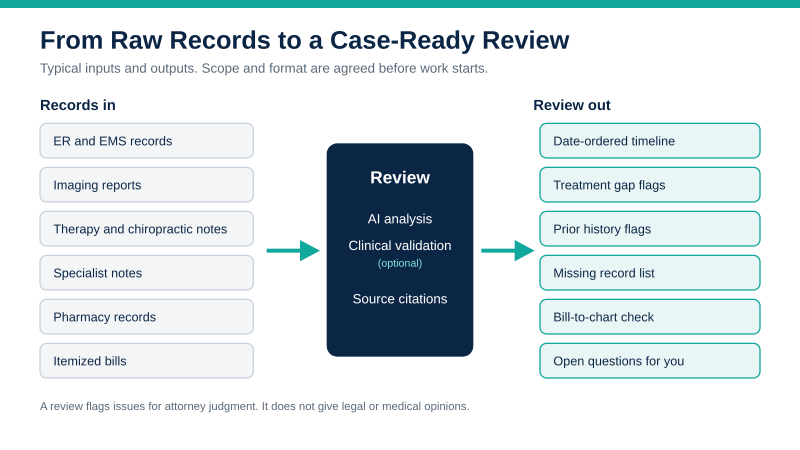
Legal medical record review should deliver an organized, source-cited picture of the file: a date-ordered treatment timeline, provider list, flagged gaps and prior history, missing record notes, and issues for attorney or expert follow-up. Format and depth vary by provider and service level, so confirm the deliverable before you order.
| Deliverable | What it gives you |
|---|---|
| Treatment timeline | Date-ordered events by provider, with page or Bates citations |
| Gap and continuity flags | Delays before first treatment, stopped care and unexplained breaks |
| Prior history flags | Earlier complaints, injuries or procedures involving the same body region |
| Missing record list | Referenced reports, imaging or visits that are not in the file |
| Bill-to-chart check | Charges with no matching note, or notes with no matching charge |
| Open questions | Items for you or an expert to decide |
Some firms also order a narrative summary for a readable overview. We cover the difference in the FAQ below.
How Does the Review Process Work, Step by Step?
A solid review follows six steps: scope the case questions, upload records securely, organize and de-duplicate, run the analysis, validate with a clinical reviewer, then deliver a cited report. You supply the incident date, body regions and goals. The reviewer returns findings tied back to the source pages.
| Step | What happens | Your part |
|---|---|---|
| 1. Scope | Define case questions, incident date, body regions and review level | Share goals and deadline |
| 2. Secure upload | Records go through a HIPAA-compliant portal | Upload every provider and bill |
| 3. Organize | Sort by date and provider, remove duplicates | Flag known missing records |
| 4. Analyze | AI scans for gaps, conflicts and prior history | Nothing needed |
| 5. Validate | Clinical reviewer checks and adds context (optional) | Answer any questions |
| 6. Deliver | Report with citations, flags and open questions | Review and decide next steps |
Which Red Flags Should a Review Catch?
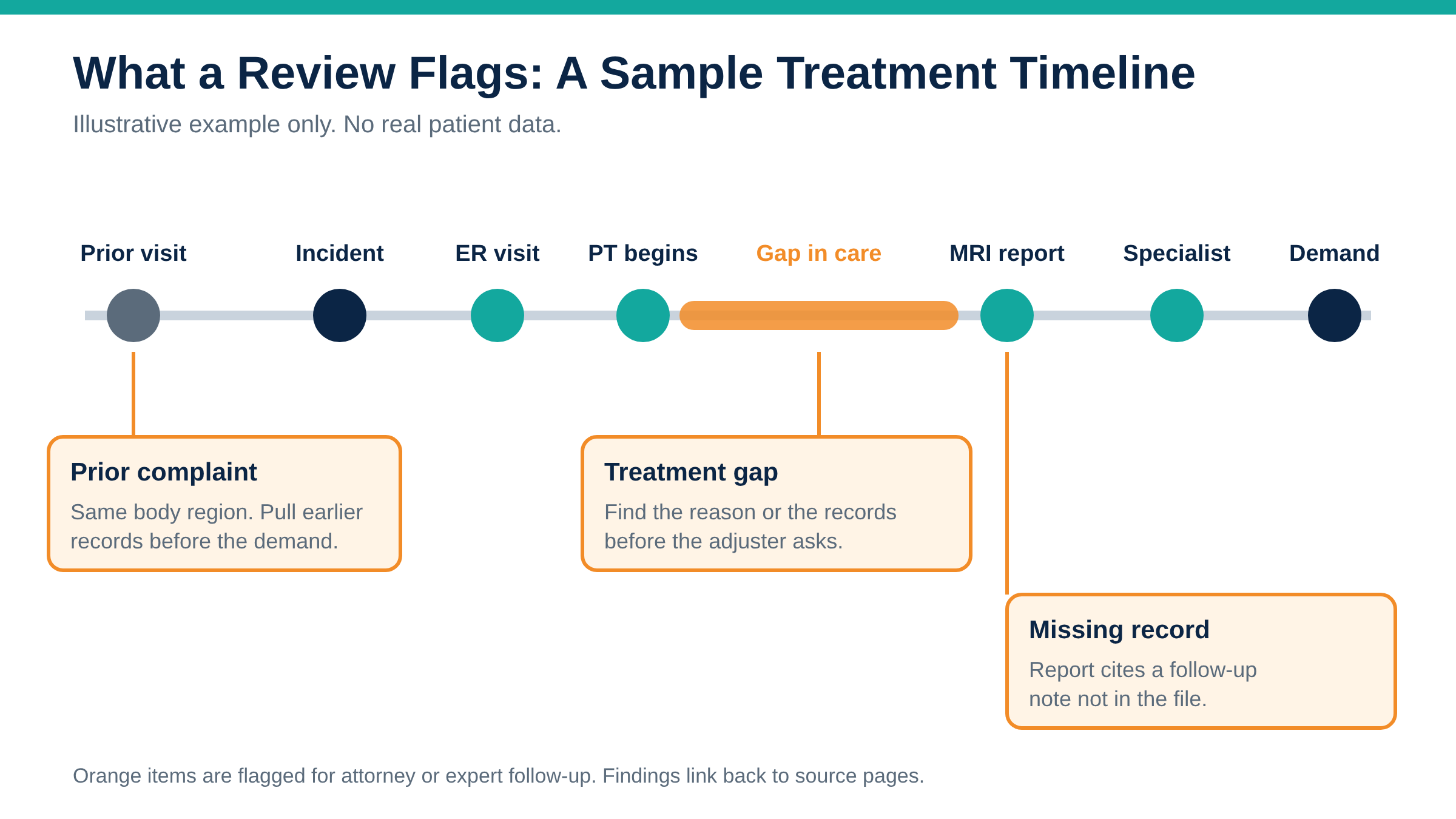
A good review catches treatment gaps, prior conditions in the same body region, inconsistent histories, conflicting diagnoses, missing records and billing that does not match the chart. Adjusters use these points to discount claims, so you want them found before the demand goes out, not during negotiation.
| Red flag | Why it matters | Typical follow-up |
|---|---|---|
| Delay before first visit | Insurers may argue the injury was minor or unrelated | Document the reason |
| Stopped or irregular care | Weakens continuity of treatment | Find records or an explanation |
| Prior complaint, same region | Central to causation and aggravation arguments | Pull earlier records |
| Conflicting histories | Different accounts of how the injury happened | Flag for attorney review |
| Referenced record not in file | Leaves the picture incomplete | Request the missing record |
| Bill with no matching note | Makes damages harder to support | Request notes or corrected bills |
Billing deserves its own look. Hospital charges start in a chargemaster, so a billed amount is not always what was paid. Whether billed or paid amounts matter for damages depends on your state, so confirm with your own research. Our guide to hospital chargemaster management explains where those charges come from.
Have a file that feels incomplete? MedVoice can run a first-pass review so you can see the gaps before you commit to a full report. Ask about a free trial.
How Do AI and Human Reviewers Work Together?
AI handles the heavy first pass, scanning records for gaps, inconsistencies and patterns across providers. A clinical reviewer then validates the findings and adds context. AI output is a suggestion for human review and never replaces attorney judgment. Use AI-only for high-volume screening and AI plus human review for files headed to a demand, deposition or mediation.
- AI-only review: fast screening for routine, high-volume files.
- AI plus human validation: clinical experts check findings and add context before the report reaches you.
- Flexibility: you can move between the two levels as the case develops.
MedVoice’s AI medical record review tool supports both levels. For a closer look at how timelines and source links are built, read our post on AI medical record summarization.
Is Legal Medical Record Review HIPAA-Compliant and Secure?
It can be, if the provider is built for it. Records usually reach your firm through a signed patient authorization under HIPAA, and your review partner should protect them with a secure upload, encryption, controlled access and clear confidentiality terms. MedVoice is HIPAA-compliant. Confirm requirements for your jurisdiction with your own counsel.
- Check the authorization. A valid HIPAA authorization must include required elements, such as who may disclose and who may receive the records (45 CFR 164.508). An incomplete form can hold up retrieval.
- Ask how records are handled. Look for secure upload, encrypted delivery, role-based access and staff training.
- Get confidentiality terms in writing before any file leaves your firm.
How Do You Choose Medical Record Review Services for Law Firms?
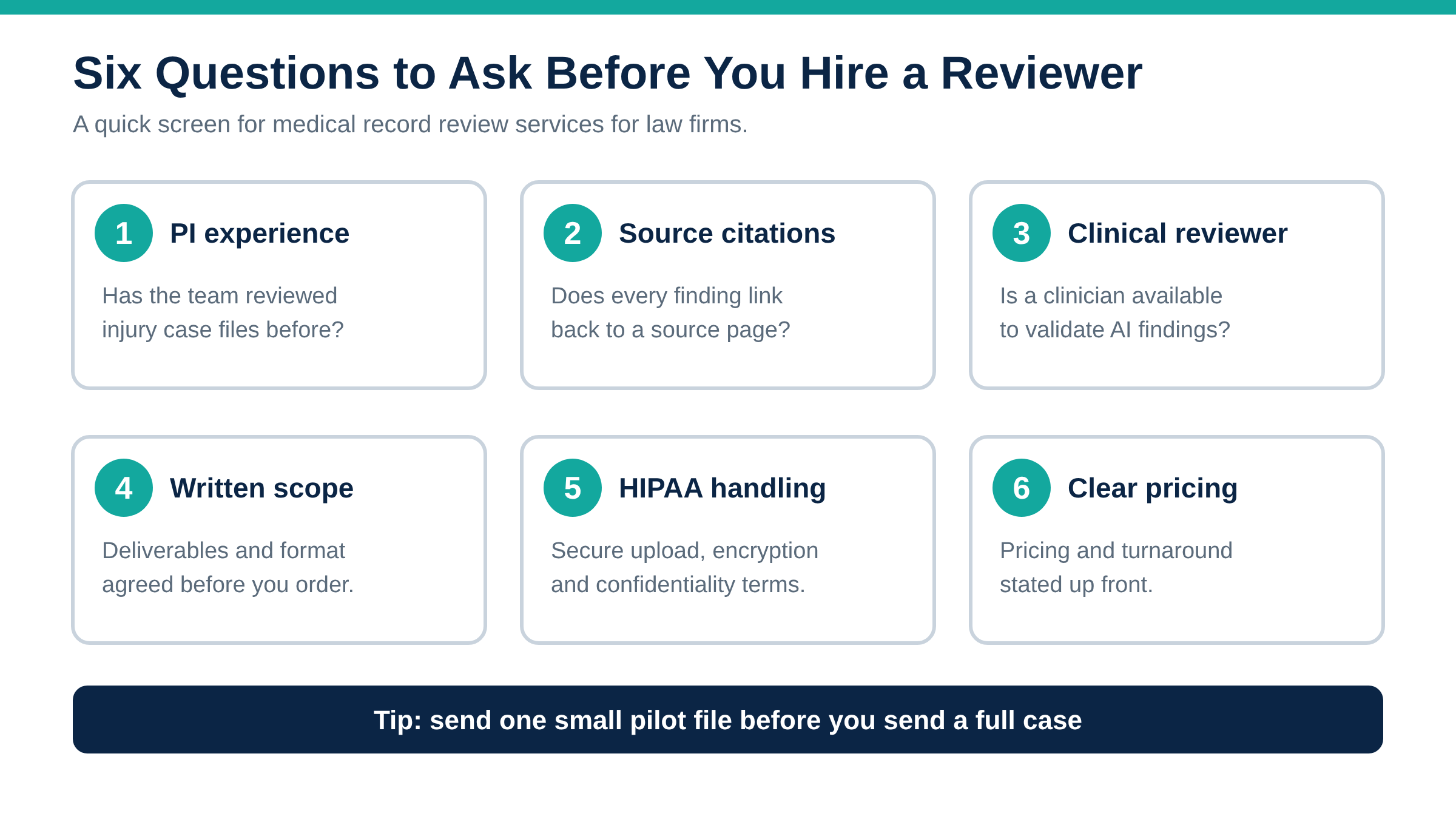
Choose medical record review services for law firms by testing six things: personal injury experience, source citations, clinical reviewer involvement, written scope and deliverables, security and HIPAA handling, and transparent pricing and turnaround. Ask for a sample or a small pilot file before you send a full case.
MedVoice’s medical record review services for law firms pair AI analysis with optional clinical validation. Pricing is pay-per-review with volume discounts, no setup or monthly fees, and a free trial. The team also works with ICD-10, CPT and HCPCS every day, with 98% coding accuracy, which helps when billed codes need to be checked against what the notes document. Learn more about our medical coding service and our guide to medical coding accuracy and compliance.
When Should You Order a Review?
Order a legal medical record review at case intake to screen viability, again before the demand to confirm support, and before depositions, mediation or trial to prepare. Early review prevents surprises, and later reviews can be narrower. Match the depth to the stage instead of ordering the heaviest review every time.
| Case stage | Review focus |
|---|---|
| Intake | Screen viability and spot prior history early |
| Pre-demand | Completeness, causation, damages and gaps |
| Deposition or mediation | Conflicts, key entries and open questions |
| Expert handoff or trial | A clean, cited timeline the expert can use |
Conclusion: Know What the Records Say Before the Adjuster Does
Medical record review for personal injury cases gives you a cited, organized view of what the records prove and where they are weak. Expect flags and open questions, not opinions. Define the scope, pick a reviewer with clinical validation, and order early enough to fix what you find.
| Get a record review you can rely on Start a free trial or talk to MedVoice about your next personal injury file. We will walk through scope, review level and what you will receive. Start your free trial Call 972-755-5474 | Toll free 855-215-5906 | sales@medvoiceinc.com |
|---|
Frequently Asked Questions
How long does a medical record review take?
It depends on page count, record complexity and whether you choose AI-only or AI plus human review. AI-only is faster, and human validation adds time. Ask for a written estimate based on your scope, and flag any hard deadline, such as a demand or mediation date, up front.
Does a record review replace an expert opinion?
No. A review organizes the records and flags issues. It does not give legal or medical opinions on causation, standard of care or case value. Those calls belong to you and your retained experts. A good review makes expert work faster because the file is already organized and cited.
What is the difference between a medical chronology and a narrative summary?
A chronology lists medical events in date order with citations. A narrative summary explains the treatment story in paragraph form. Chronologies suit depositions and expert prep, while summaries help with quick understanding. Many firms order both, built from one reviewed record set.
Is the review different for plaintiff and defense teams?
The records are the same, but the emphasis differs. Plaintiff teams focus on injury severity, continuity of treatment and damages support. Defense teams focus on causation, prior conditions and inconsistencies. Tell the reviewer which side you represent so findings match your case questions.
What records should I send for review?
Send everything you have: ER and EMS records, imaging reports, therapy and specialist notes, pharmacy records, itemized bills and any prior records. Include the incident date, body regions at issue and your key questions. Missing items are fine, because the review should list what is absent.
Sources
- Expert Institute, Medical Record Review vs. Medical Chronology. What a record review covers: causation, preexisting conditions, treatment gaps, missing records.
- Expert Institute, Medical Record Reviews Build Stronger Demand Letters. Questions a demand-focused review should answer before a letter goes out.
- ChartRequest, Medical Record Review for Personal Injury Lawyers. Checking completeness, consistency and damages documentation against the treatment timeline.
- LezDoTech, Records Look Complete but Case Questions Are Unanswered. Bills that do not match treatment records.
- Tavrn, Personal Injury Medical Chronology. Treatment gaps and pre-existing conditions as the common weak points in PI chronologies.
- HHS, FAQ 471: Authorization for an entire medical record. HIPAA authorizations under 45 CFR 164.508.
- Cornell Legal Information Institute, 45 CFR 164.508. Required elements of a valid HIPAA authorization.