A chargemaster is the master list of every billable item and service in a hospital, with codes and prices. Accurate charge master management keeps codes current, prices consistent and charges flowing correctly to claims. That cuts avoidable denials, protects revenue and supports CMS price transparency rules.
One Bad Chargemaster Line Follows Every Claim
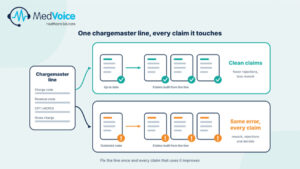
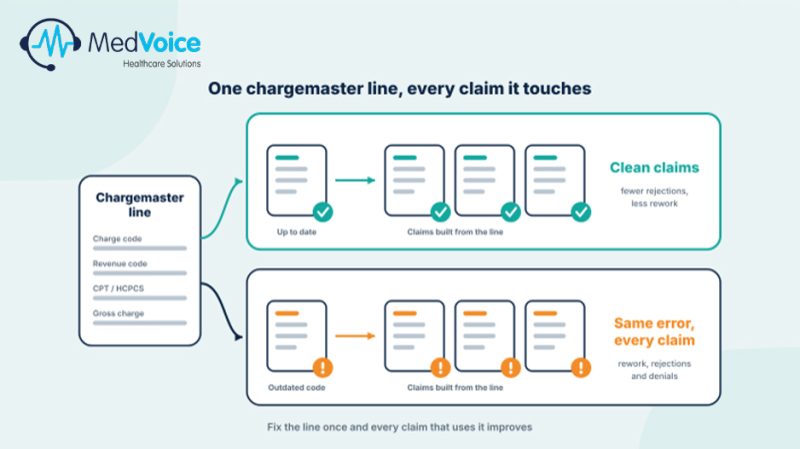
One outdated line in your chargemaster does not stay one error. It repeats on every claim that touches that charge, so denials, rework and compliance questions pile up from a single bad row.
MedVoice supports hospital medical billing with a denial rate of less than 3% and a 98% clean claim submission rate. That starts upstream, with accurate charge data. This guide covers what a chargemaster is, why it matters, where it breaks and how to build charge master management that holds up.
Figure 1: A single chargemaster line feeds every claim, so one fix improves them all.
Key takeaways
- The chargemaster feeds every claim in hospital medical billing, so errors multiply fast.
- Gross charges in your chargemaster are part of what CMS requires hospitals to publish.
- Most problems come from stale codes, mismatched revenue codes and no clear owner.
- Strong charge master management comes from a fixed calendar and a cross-functional team, not an annual scramble.
- Technology can flag issues, but people make the final call.
What Is a Chargemaster?
A chargemaster, also called a charge description master (CDM), is the master file of every item and service a hospital bills, with internal codes, descriptions, revenue codes and prices. It turns documented care into charges on the claim, so any error in the file repeats on every claim that uses it.
Each line usually includes:
- An internal charge code and a plain-language description
- A revenue code, plus a CPT or HCPCS code where applicable
- Modifiers and units of service
- The gross charge, which is the full price before discounts or contractual adjustments
- The department or cost center responsible
When care is ordered and documented, the CDM line turns it into a charge on the claim. If the line is wrong, the claim starts wrong.
Why Does the Chargemaster Matter for Hospital Medical Billing?
The chargemaster sits between clinical activity and the claim, so it shapes reimbursement accuracy, charge capture and compliance. Payers check claim codes against their edits, missing charges never get billed, and gross charges feed the pricing data CMS requires hospitals to publish.
- Reimbursement accuracy: payers check the codes and revenue codes on your claim against their edits and contract terms. A mismatched revenue code or an obsolete HCPCS code can trigger a rejection before anyone looks at the care provided.
- Charge capture: services missing from the CDM, or mapped to the wrong department, often never get billed. No appeal recovers a charge that was never submitted.
- Compliance: your gross charges feed the public pricing data CMS requires hospitals to post. Errors are visible to patients, payers and regulators.
How Does the Chargemaster Connect to Price Transparency?
Under the CMS hospital price transparency rule, hospitals must post standard charges online in a machine-readable file and show a consumer-friendly list of shoppable services. The gross charge, the price in your chargemaster before discounts, is one of those standard charges, so CDM errors become public.
The rule sits in 45 CFR Part 180. In practice, that means three things:
- Your CDM is public-facing: inconsistent prices, vague descriptions and stale entries are easy to spot.
- Updates are expected at least once a year: many teams tie this to the annual CMS payment rule cycle.
- Requirements keep changing: CMS refines data elements and enforcement through its annual outpatient payment rules. Confirm current requirements with CMS and your compliance counsel each year.
Price transparency makes a clean CDM a shared job across finance, compliance and patient access, not only the billing office.
What CDM Errors Cost Hospitals Revenue?
Common CDM errors are small but repeat on every claim that uses the line: outdated codes, revenue code mismatches, inconsistent prices, missing or duplicate lines, vague descriptions and no clear owner. The result is rejections, unbilled services and audit questions.
| Error | What it causes |
| Outdated codes | Rejections and denials when the CDM falls behind CPT, HCPCS or ICD-10 updates |
| Revenue code mismatch | Payer rejections even when the CPT or HCPCS code is right |
| Inconsistent pricing | Audit questions and confused patients, for example a contrast study priced below the same study without contrast |
| Missing or duplicate lines | Unbilled services, or retired items billed by mistake |
| Vague descriptions | Charge entry errors and extra coding queries |
| No clear owner | Informal changes with no review trail |
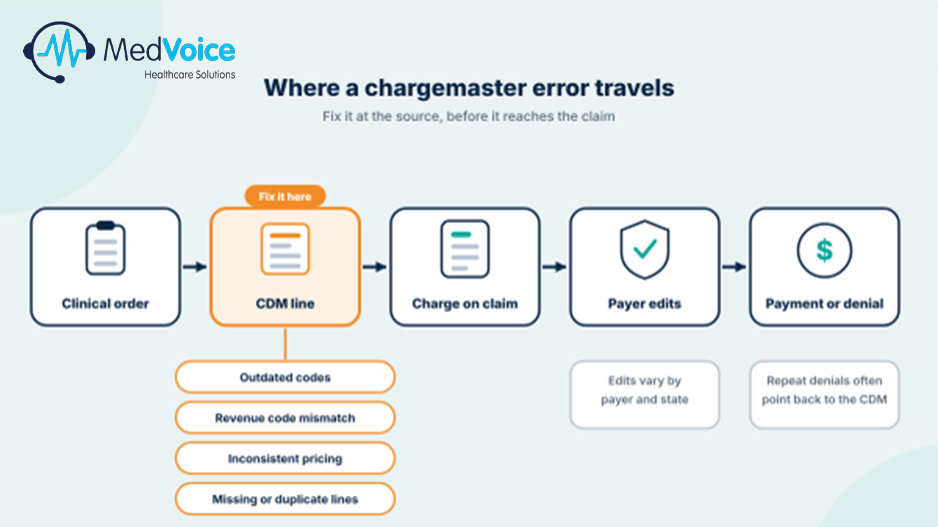
Figure 2: Where a chargemaster error travels, and the problems to fix at the CDM line.
Denial reasons, edits and coding requirements vary by payer and by state, so review your CDM against the payers you bill most.
What Are the Best Practices for Charge Master Management?
Good charge master management is a repeatable process. Build a cross-functional team, name one owner, update codes on a fixed calendar, test pricing logic, tie charge capture back to the CDM, audit on a schedule and mine denials for CDM patterns.
- Build a cross-functional team: HFMA guidance on CDM maintenance recommends including finance, patient financial services, health information management, compliance and each ancillary department such as lab, radiology and pharmacy.
- Assign one owner: name a CDM owner, often in revenue integrity, who approves every addition, change and retirement. Record the request, the approver and the effective date.
- Update codes on a fixed calendar: tie reviews to code release cycles, with CPT in January, HCPCS quarterly and ICD-10 each October.
- Test your pricing logic: ask whether each price is defensible, consistent with similar services, logical across related procedures and in line with your payer fee schedules.
- Tie charge capture back to the CDM: compare what departments capture with what reaches the claim. Gaps usually point to missing CDM lines, wrong mapping or manual workflows.
- Audit on a schedule: run department reviews through the year and consider an independent annual review. Fresh eyes catch what familiarity hides.
- Mine denials for CDM patterns: when the same code, revenue code or department shows up again and again in denial reports, the root cause is often the CDM. Our denial management services are built around this feedback loop.
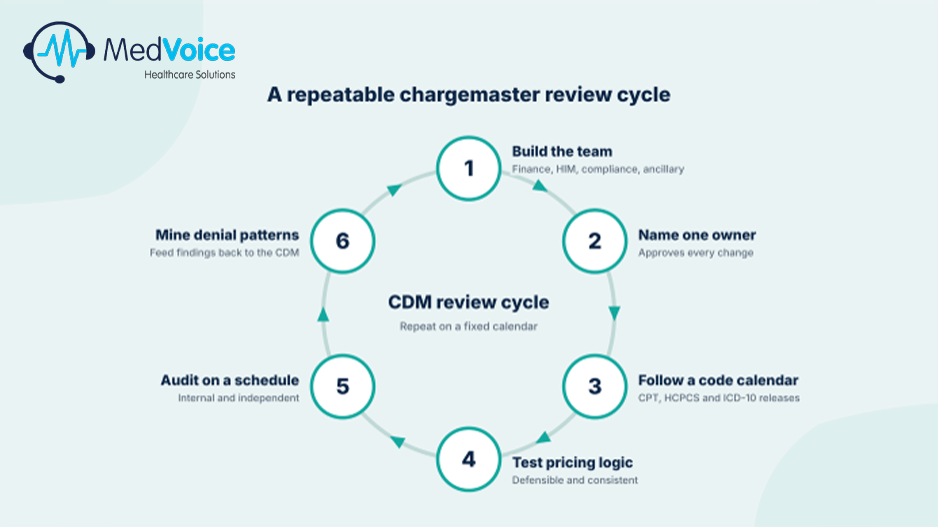
Figure 3: A repeatable review cycle keeps the chargemaster current.
Is your CDM leaking revenue? Not sure how your charge master management lines up with your denial trends? MedVoice offers a free revenue audit that looks at your billing workflow, coding and denial patterns. Request a free revenue audit and see where the gaps are.
How Does Technology Help With Charge Master Management?
Technology helps by validating CDM lines against current code sets, reconciling captured charges with billed charges and connecting CDM changes to claim and denial results. AI tools produce suggestions for human review, and your coders and revenue integrity team make the final calls.
Manual upkeep does not scale in hospital medical billing across departments and facilities. Technology helps in three ways:
- Code validation: software compares CDM lines against current code sets and flags entries for review.
- Charge reconciliation: reports surface charges captured but not billed, or billed without support.
- Visibility: dashboards connect CDM changes to claim and denial results.
MedVoice includes proprietary AI tools, such as medical billing software and an AI medical scribe and coding tool, with billing services. They produce suggestions for human review, and certified coders and your revenue integrity team make the final decisions. Our medical coding team supports hospital medical billing within that same review process.
How Does MedVoice Support Hospital Medical Billing?
MedVoice supports hospital medical billing with end-to-end revenue cycle management, coding support, denial prevention that traces problems back to upstream causes such as the chargemaster, and medical record review. Pricing starts as low as 3% with no hidden fees, and every process is HIPAA-compliant.
- End-to-end revenue cycle management, from charge capture to payment posting
- Coding support across inpatient and outpatient services using CPT, ICD-10 and HCPCS
- Denial prevention that traces problems back to upstream causes, including the chargemaster
- Medical record review to confirm documentation supports billed charges
- Coding validation and denial trend reporting that give your team data for charge master management reviews
- Transparent pricing starting as low as 3%, with no hidden fees
- HIPAA-compliant processes at every step
Together, these help healthcare organizations achieve a 15% increase in revenue collection. See how it works on our hospital medical billing services page.
For more on hospital revenue, read our post on optimizing the patient financial experience, see how AI supports clean claims and lower A/R days, and learn why dedicated radiology billing expertise matters for ancillary charges.
Quick Guide: Is Your Chargemaster Ready for Review?
Use this checklist before your next chargemaster review. If you cannot check every item, start with the owner and the code calendar, then work through pricing, descriptions, published gross charges and denial trends. Each unchecked box is a place where an error can repeat on every claim.
| Review item | What to confirm |
| Owner and process | A named CDM owner and a written change-approval process |
| Codes | CPT, HCPCS and revenue codes checked against current releases |
| Descriptions | Clear to clinicians, coders and patients |
| Pricing | Reviewed for consistency and defensibility |
| Retired items | Obsolete and duplicate lines removed |
| Public data | Published gross charges match the internal CDM |
| Denials | Denial trends checked for CDM-related causes |
| Charge capture | Captured charges compared with billed charges by department |
Where Should You Start With Your Chargemaster?
Start with three things: one named owner, a fixed code-update calendar and a regular look at denials by code and department. Those steps are simple to put in place, catch problems early and give your billing team a cleaner starting point for every claim in hospital medical billing.
You do not need a full overhaul to make progress. A clean CDM gives your billing team a solid start on every claim, and steady charge master management keeps it that way. MedVoice can help you connect charge data, coding and denials in hospital medical billing.
Want a second set of eyes on your chargemaster and denial trends? Start with a free revenue audit or schedule a consultation. Schedule a Consult or call 972-755-5474.
Email: sales@medvoiceinc.com | Phone: 972-755-5474 | Toll free: 855-215-5906
Frequently Asked Questions
How often should a hospital update its CDM?
At least once a year, and more often when code sets change. CPT updates take effect each January, HCPCS Level II codes update quarterly and ICD-10 changes arrive each October. Also review the CDM whenever you add a service line, device or drug.
What is the difference between a chargemaster and a fee schedule?
A chargemaster lists the hospital’s gross charge for each item or service. A fee schedule, such as Medicare’s or a commercial payer’s contracted rates, shows what the payer will allow. The gap between the two is the contractual adjustment.
Who should own the chargemaster?
One named person, often in revenue integrity or finance, should approve every change. That owner works with a cross-functional team of coding, compliance, patient financial services and department leaders so charge master management changes are documented and reviewed.
Can a chargemaster cause claim denials?
Yes. Obsolete codes, wrong revenue codes and mismatched descriptions can lead to rejections and denials. Specific edits vary by payer and state, so tracking denial patterns by code and department helps trace issues back to the CDM.
Can a billing partner help with charge master management?
Yes. A billing partner with hospital medical billing, coding and denial expertise can spot CDM-driven denials, validate codes and support your revenue integrity team. MedVoice works alongside your internal staff, and your hospital keeps final decisions.
This article is for general information. Chargemaster requirements, coding rules and payer policies change and vary by payer and state. Confirm current requirements with CMS, your compliance team and legal counsel.
Sources
HFMA, How Chargemaster Maintenance Can Contribute to Price Transparency (team structure, pricing questions)
CMS, Hospital Price Transparency technical guide (45 CFR Part 180) (standard charges, machine-readable file)
Healthcare Finance News, Optimizing the chargemaster: Best practices (ongoing review, annual external review)