
Radiology practices handle complex imaging services every day, but getting those services paid correctly can be just as complicated. Radiology billing challenges can arise from coding requirements, documentation gaps, medical necessity, authorization, payer policies, and professional and technical component billing.
For radiology practices and healthcare organizations, billing is more than submitting claims. A small coding or documentation issue can create rework, delay reimbursement, and add pressure to an already busy billing team.
That is why radiology billing requires more than general medical billing knowledge. It requires an understanding of how imaging services are documented, coded, reported, and reimbursed.
Why Is Radiology Billing So Complex?
Radiology billing is complex because imaging services involve specialty-specific coding, documentation requirements, modifiers, medical necessity rules, authorization requirements, and professional and technical components.
A specialized billing process can help identify these issues before they turn into avoidable claim errors, denials, or delayed reimbursement.
Why Radiology Billing Requires Specialized Expertise
Radiology billing involves several connected steps:
- Patient registration and insurance verification
- Authorization when required
- Imaging services and clinical documentation
- Radiology coding
- Modifier and component reporting
- Claim submission
- Payment posting and reconciliation
- Denial follow-up and A/R management
An error at any stage can affect the claim that follows.
For example, incomplete documentation may create a coding issue. An incorrect modifier may affect how a service is reported. Missing authorization may result in a denial. A payer-specific requirement that is overlooked can delay payment.
The challenge is not simply fixing these issues after a claim is denied. It is identifying where the problem begins and preventing the same issue from affecting future claims.
For practices that need broader billing support, medical billing services can provide support across claim submission, payment posting, follow-up, and other billing functions.
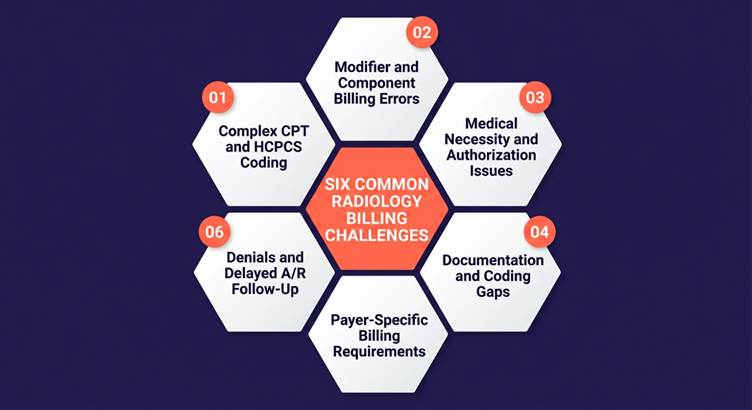
6 Common Radiology Billing Challenges
1. Complex CPT and HCPCS Coding
Radiology coding brings together CPT codes for imaging procedures and HCPCS Level II codes for related supplies and equipment, and both must be accurate for a claim to be reimbursed correctly.
Key elements of radiology CPT and HCPCS coding include:
- CPT codes: Five-digit numeric codes that identify the specific imaging service performed, such as an X-ray, CT scan, or MRI
- HCPCS Level II codes: Alphanumeric codes that identify supplies used during imaging, such as contrast materials
- Modifiers: Two-character additions that clarify details like laterality (left, right, or bilateral) or whether the professional and technical components are billed separately
- Documentation requirements: Codes at this level of specificity require documentation that matches, such as the body part imaged, contrast use, and views taken
- Medical necessity: Each CPT code must connect to a supporting ICD-10-CM diagnosis code to show the imaging service was medically necessary
2. Modifier and Component Billing Errors
One of the areas that makes radiology billing different from many other specialties is the need to correctly report professional and technical services.
Depending on the service and setting, billing may involve:
- Professional component: The physician’s interpretation and report
- Technical component: The equipment, facility, and technical resources used to perform the imaging service
- Global service: When both components are reported together when applicable
Incorrect component reporting or modifier use can result in claim errors, incorrect reimbursement, or denials.
For radiology practices, understanding the difference between the 26 professional modifier and TC technical component is particularly important when applicable to the service being billed.
3. Medical Necessity and Authorization Issues
A radiology claim may require supporting documentation or prior authorization depending on the service, payer, and circumstances.
When authorization requirements are missed or the documentation does not adequately support medical necessity, the claim may face additional review or denial.
This makes front-end verification important.
Checking eligibility, authorization requirements, and available documentation before the claim reaches the payer can help reduce preventable billing problems.
4. Documentation and Coding Gaps
The medical record should support the service reported on the claim.
When documentation is incomplete or does not clearly support the billed service, coding and billing teams may have difficulty reporting the claim accurately.
Common areas to review include:
- Procedure documentation
- Diagnosis information
- Physician interpretation and report
- Medical necessity support
- Modifier requirements
- Professional and technical components
Better coordination between clinical documentation, coding, and billing can help reduce avoidable claim issues.
5. Payer-Specific Billing Requirements
Not every payer handles radiology claims in exactly the same way.
Payer policies can affect authorization, medical necessity, claim submission, coding requirements, and reimbursement.
A billing team that monitors payer-specific requirements can identify changes and recurring issues instead of treating every denial as an isolated event.
6. Denials and Delayed A/R Follow-Up
A denied radiology claim is not simply a payment problem. It can also create additional administrative work.
If the same denial reason keeps appearing, repeatedly correcting individual claims does not solve the underlying issue.
A stronger radiology denial management process looks for patterns.
A practical denial workflow includes:
- Categorizing denial reasons
- Reviewing the original claim
- Checking coding and documentation
- Identifying authorization or medical necessity issues
- Correcting and resubmitting eligible claims
- Tracking recurring denial trends
- Using those findings to prevent future denials
The goal is to move from reactive denial correction to proactive denial prevention.
How Radiology Practices Can Improve Billing Accuracy
Improving radiology billing does not begin when a claim is denied. It begins before submission.
A more consistent process should review:
- Patient and insurance information
- Eligibility
- Authorization requirements
- Documentation
- Radiology-specific coding
- Modifier usage
- Professional and technical components
- Claim information
- Payer-specific requirements
These checks can help identify errors earlier and reduce unnecessary rework.
For practices handling a high volume of imaging services, consistent quality checks can also make it easier to identify recurring problems across payers, procedures, and claims.
What Should You Look for in a Radiology Billing Partner?
Choosing a billing company based only on claim submission capabilities may not be enough for a radiology practice.
Before selecting a billing partner, ask:
Does the team have radiology-specific experience?
Radiology billing has requirements that differ from general medical billing. Ask how familiar the team is with imaging services, coding, modifiers, and professional and technical components.
How are coding errors identified?
Find out whether the billing process includes coding quality checks before claims are submitted.
How are denials analyzed?
A good denial-management process should identify recurring causes rather than simply resubmit denied claims.
How are payer requirements monitored?
Payer policies can change. Ask how the billing team identifies and responds to payer-specific requirements.
What reporting will you receive?
Your billing partner should provide visibility into claims, denials, A/R, reimbursement, and recurring billing issues.
The goal is not simply to outsource billing tasks. It is to have a process that gives the practice better visibility into what is going wrong, why it is happening, and how it can be prevented.
Why Specialized Radiology Billing Matters
Radiology billing combines specialty-specific coding, documentation, payer requirements, authorization, and component billing. When these areas are not managed consistently, practices can face avoidable claim errors, denials, delayed reimbursement, and additional administrative work.
A specialized approach can help radiology practices strengthen the billing process from claim preparation through denial follow-up.
The right billing partner should combine radiology billing expertise, coding quality controls, technology, reporting, and proactive denial management rather than treating billing as simple claim submission.
Frequently Asked Questions
What are the most common radiology billing challenges?
Common radiology billing challenges include coding errors, incorrect modifiers, medical necessity issues, authorization problems, documentation gaps, payer-specific requirements, professional and technical component billing, and claim denials.
Why does radiology billing require specialized expertise?
Radiology involves imaging-specific coding, documentation, modifiers, medical necessity requirements, and professional and technical components. Specialized knowledge helps billing teams manage these requirements more accurately.
What is the difference between the professional and technical components in radiology billing?
The professional component generally relates to the physician’s interpretation and report, while the technical component relates to the equipment, facility, and technical resources used to perform the imaging service. How these components are reported depends on the service and billing circumstances.
How can radiology practices reduce claim denials?
Practices can reduce preventable denials by reviewing eligibility, authorization, documentation, coding, modifiers, medical necessity, and payer requirements before claim submission. Tracking denial patterns can also help prevent recurring problems.
What should I look for in a radiology billing company?
Look for radiology-specific experience, coding quality controls, denial-management processes, payer knowledge, transparent reporting, technology integration, and a workflow that fits your practice.
Can outsourced radiology billing improve revenue cycle performance?
Specialized billing support can help practices improve claim accuracy, manage denials, follow up on unpaid claims, and reduce administrative rework. The impact depends on the practice’s existing processes, payer mix, claim volume, and billing performance.
Strengthen Your Radiology Billing Process With MedVoice
Radiology billing requires specialized knowledge at every stage, from coding and documentation to claim submission and denial management.
If your radiology practice is dealing with recurring denials, billing errors, or growing A/R, MedVoice can help identify where the billing process is losing efficiency and build a more consistent approach to revenue cycle management.