Payment posting in medical billing is the step where payments, adjustments and patient balances from a remittance are recorded against the right claim. Done well, it keeps A/R accurate, surfaces denials and underpayments early, and shows the true state of your cash. Done poorly, it hides revenue problems.
Paid Is Not the Same as Posted
A payer can send the money and your A/R report can still show the claim as unpaid. That gap is a posting problem. It sends staff chasing claims that are already paid while real underpayments slip by.
Payment posting in medical billing is where cash, remittance data and your A/R finally meet. MedVoice builds its process to reduce A/R days by 40%, and accurate posting is where that starts. This guide walks through the process, the errors that cost practices revenue and the best practices that keep medical payment posting clean.
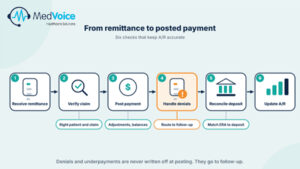
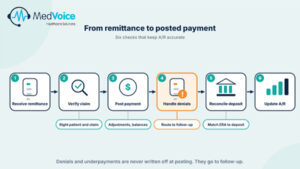
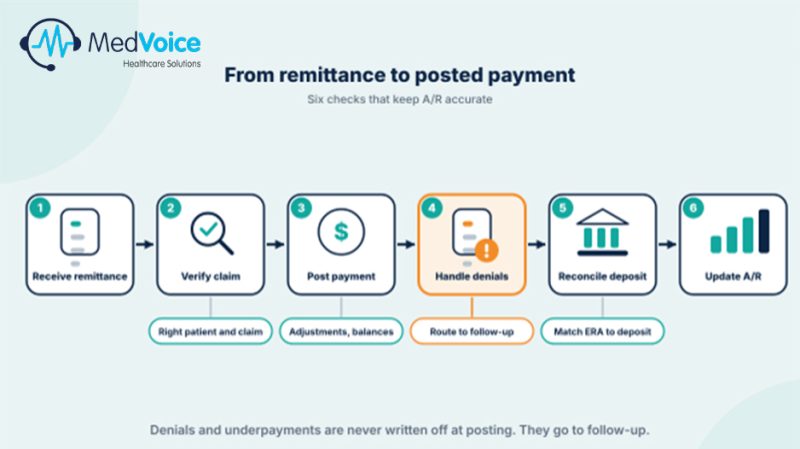
Figure 1: Six checks take a remittance from received to posted.
Key takeaways
- Payment posting in medical billing turns remittance data into accurate balances.
- An ERA is the electronic version of the payer’s explanation, and it drives remittance posting.
- Daily payment posting in medical billing and regular reconciliation keep A/R and cash in sync.
- Auto-posting speeds medical payment posting, but exceptions still need human review.
What Is Payment Posting in Medical Billing?
Payment posting in medical billing is the process of recording insurance and patient payments, along with contractual adjustments and denials, against the correct claim and account. It turns the details on a remittance into updated balances, so your A/R report shows what is paid, what is owed and what needs follow-up.
Each posting records:
- The payer payment, at the claim or service-line level
- Contractual adjustments, based on the payer contract
- Patient responsibility, such as deductible, copay or coinsurance
- Denials and partial payments, with their reason and remark codes
Medical payment posting is a data step that drives money decisions. Follow-up calls, patient statements and secondary claims all depend on it.
What Do ERA, EOB and EFT Mean for Remittance Posting?
An EOB is the payer’s explanation of how a claim was processed. An ERA is the electronic version, delivered in the X12 835 format. An EFT is the actual money transfer. Remittance posting uses the ERA or EOB to record what happened, then matches it to the deposit.
| Term | What it is |
| EOB (explanation of benefits) | The payer’s explanation of how a claim was processed |
| ERA (electronic remittance advice) | The electronic remittance, sent in the HIPAA X12 835 format |
| EFT (electronic funds transfer) | The payment itself, which is separate from the explanation |
| CARC (claim adjustment reason code) | Explains why a claim or service line was paid differently than billed |
| RARC (remittance advice remark code) | Adds detail to an adjustment or conveys remittance information |
How Does Payment Posting Work Step by Step?
Here is how payment posting in medical billing works in eight steps, from receiving the remittance to updating the account. Each step protects A/R accuracy, and skipping one usually shows up later as a rejected secondary claim or a patient dispute.
- Step 1, receive the remittance: collect the ERA, EOB, EFT notice or check details.
- Step 2, verify the claim: confirm patient, claim and date of service.
- Step 3, review the breakdown: check billed, allowed and paid amounts, patient responsibility, adjustments and codes.
- Step 4, post the payment: record it at the claim or line level.
- Step 5, post adjustments and patient balance: apply contractual adjustments and move deductible, copay or coinsurance to the patient.
- Step 6, handle denials and partial payments: record reason and remark codes, then route the claim to follow-up.
- Step 7, reconcile: match posted totals to the ERA and the deposit.
- Step 8, update the account: refresh claim status and balances for secondary billing and statements.
What Are the Types of Medical Payment Posting?
Medical payment posting is done manually, electronically from an ERA or through auto-posting rules. Manual posting suits low volume and complex exceptions but carries more keying risk. ERA-based and auto-posting scale better for routine remittances, though denials, underpayments and unmapped codes still need human review.
| Method | Best for | Watch out for |
| Manual posting | Low volume and complex exceptions | Keying errors and backlogs |
| ERA-based remittance posting | Routine, standardized payer remittances | Payer mapping, testing and ongoing monitoring |
| Auto-posting | High volume with clear rules | Mismatches and exceptions that need review |
Which Payment Posting Errors in Medical Billing Cost Practices Revenue?
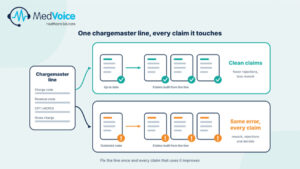
Common errors in payment posting in medical billing are quiet ones: a payment applied to the wrong claim, an incorrect write-off, a keying slip, an unmapped code or a duplicate posting. Each one distorts A/R, and the damage spreads to follow-up work, patient statements and secondary claims.
| Error | What it causes |
| Payment posted to the wrong patient or claim | Paid claims look unpaid, so staff chase money already collected |
| Incorrect adjustment or write-off | Distorted A/R reports and lost chances to appeal or rebill |
| Unmapped codes and auto-post failures | Exception queues that grow and slow cash visibility |
| Duplicate postings and unapplied cash | Reconciliation variances that are hard to trace |
| Wrong primary payment or balance data | Rejected secondary and tertiary claims |
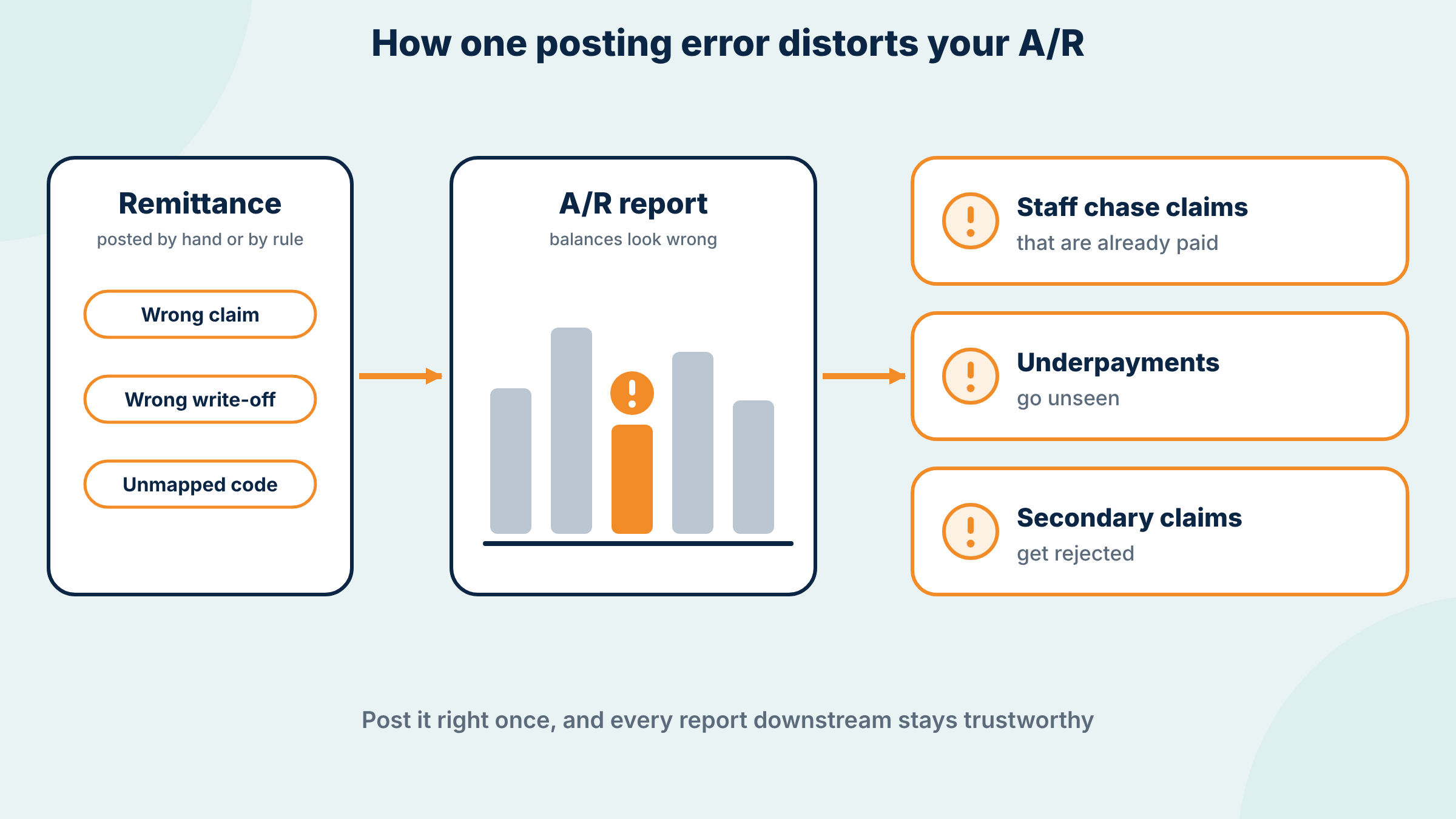
Figure 2: One posting error can distort the A/R report and everything that depends on it.
Adjustment rules and remittance formats vary by payer and state.
What Are the Best Practices for Payment Posting in Medical Billing?
Strong payment posting in medical billing comes down to a few habits: post daily, verify before you post, review every remittance line, write off only contractual differences, route denials and underpayments to follow-up, reconcile to deposits, separate duties and track KPIs.
- Post daily: same-day medical payment posting keeps A/R aging and cash visibility current.
- Verify before posting: confirm the patient, claim and date of service.
- Review every remittance line: check for underpayments and denial codes before finalizing.
- Write off only contractual differences: only the gap between the billed amount and the contracted rate is a normal adjustment. Anything else needs supervisor approval.
- Route denials and underpayments: never write them off at posting. Send them to follow-up or to denial management.
- Reconcile to deposits: match posted totals to the ERA, EFT and bank deposits.
- Separate duties: different people should post, review and approve write-offs.
- Track KPIs and audit: watch turnaround time, percent posted within 24 hours, posting accuracy, auto-post and exception rates, and reconciliation variance.
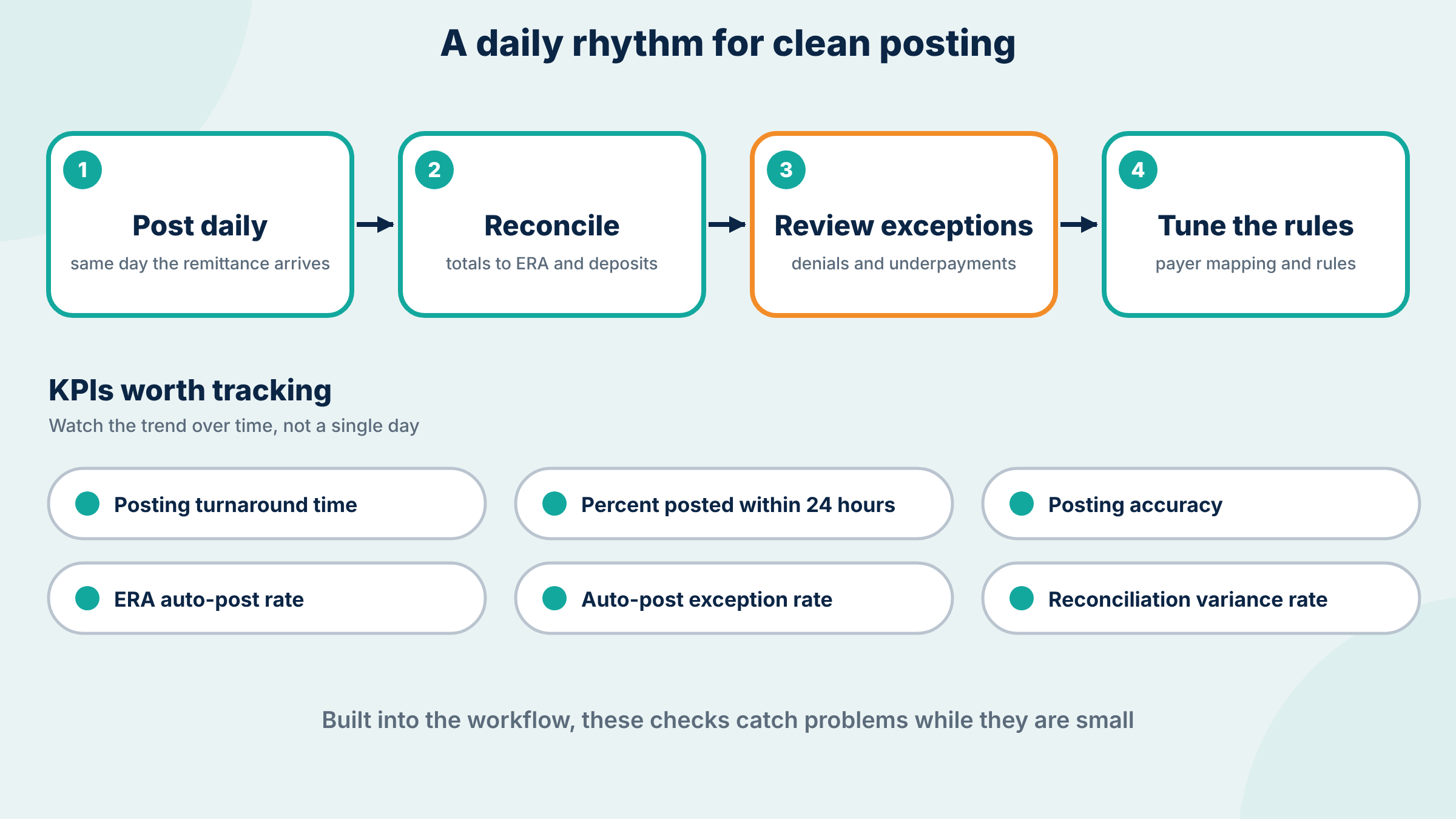
Figure 3: A daily rhythm and a short KPI list keep posting on track.
Is your remittance posting catching underpayments? MedVoice offers a free revenue audit of your billing workflow, posting and denial patterns. Request a free revenue audit today.
How Does Payment Posting in Medical Billing Affect A/R Days and Denials?
Payment posting in medical billing feeds A/R aging, so errors flow straight into A/R days and denial work. When posting is accurate and timely, follow-up teams chase only what is truly open. When it is not, they spend time on paid claims while real denials and underpayments age.
That is why MedVoice treats medical payment posting as part of full revenue cycle management, not a separate chore. If your A/R days are high, check posting lag and unapplied cash before blaming payers. Related reading: why A/R days run high and how to fix them, RCM KPIs to track and how AI reduces claim denials.
How Does Technology Help With Remittance Posting?
Technology helps remittance posting by reading ERA data, matching each 835 to its claim, applying adjustment rules and routing exceptions to staff. AI tools offer suggestions for human review, so your team approves unusual adjustments, denials and underpayments instead of keying every line.
- ERA auto-posting: speeds medical payment posting by posting payments and adjustments from the 835 using your billing rules.
- Claim matching: pairs each remittance line with its claim and flags unmatched lines.
- Exception routing: sends denials, underpayments and mapping failures to the right queue.
MedVoice includes proprietary AI tools, such as medical billing software and an AI medical scribe and coding tool, with billing services. They produce suggestions for human review, and your team keeps the final call.
How Does MedVoice Support Payment Posting in Medical Billing?
MedVoice supports payment posting in medical billing with daily posting, ERA processing, adjustment management, bank reconciliation and variance analysis, backed by detailed financial and denial reporting. Pricing starts as low as 3% with no hidden fees, and every process is HIPAA-compliant.
- Daily payment posting and adjustment management
- ERA processing and bank reconciliation
- Variance analysis to catch posting and payment gaps
- Detailed financial and denial reporting through a client portal
Together, these help healthcare organizations achieve a 15% increase in revenue collection. See how posting fits into our full medical billing services.
Quick Guide: Is Your Payment Posting Process Healthy?
Use this checklist to see where payment posting in medical billing stands in your practice. If you cannot check every item, start with same-day posting and reconciliation, then work through adjustment rules, exception routing and reporting. Each gap lets A/R drift from the truth.
| Check | What to confirm |
| Timing and checks | Payments post the day they arrive, after verification |
| Remittance posting review | Every line is reviewed for underpayments and denial codes |
| Adjustments | Write-offs are limited to contractual differences, with approval for the rest |
| Exceptions | Denials and underpayments go to follow-up, not to a write-off |
| Reconciliation | Posted totals are matched to the ERA, EFT and deposits |
| Controls and reporting | Duties are separated and KPIs are reviewed regularly |
Where Should You Start With Payment Posting in Medical Billing?
Start with three things: post on the day payments arrive, reconcile to deposits on a fixed schedule and send every denial and underpayment to follow-up instead of writing it off. Those habits are simple to put in place and make every A/R report more trustworthy.
You do not need a new system to improve payment posting in medical billing. You need clear rules, daily habits and someone watching the exceptions. MedVoice can take medical payment posting, reconciliation and follow-up off your plate.
Want a second set of eyes on your remittance posting and A/R? Start with a free revenue audit or schedule a consultation. Schedule a Consult or call 972-755-5474.
Email: sales@medvoiceinc.com | Phone: 972-755-5474 | Toll free: 855-215-5906
Frequently Asked Questions
What is the difference between payment posting and payment reconciliation?
Payment posting records each payment, adjustment and balance against a claim. Reconciliation checks that the totals from remittance posting match the ERA and the money that reached the bank. Posting builds the record, and reconciliation proves it is complete and correct.
Can payment posting in medical billing be automated without review?
Routine ERA lines with clear rules can usually auto-post, but not everything should. Denials, underpayments, unmapped codes and mismatches need a person. Most teams auto-post standard remittances, review exceptions by hand and test payer rules regularly. Start with your highest-volume payers.
Should a practice handle payment posting in medical billing in-house or outsource it?
It depends on volume, staffing and visibility. In-house posting works when the team can post daily, reconcile and follow up. Outsourcing helps when backlogs grow, because a billing partner can add reconciliation, reporting and denial follow-up. Ask how exceptions are handled.
How are patient payments posted?
In medical payment posting, copays, deductibles and coinsurance go to the patient’s account and are matched to the balance left after the insurer pays. Post them the day they arrive, apply them to the right encounter and reconcile them with deposits. Wrong amounts lead to billing disputes.
How does posting affect secondary claims?
Secondary claims depend on the primary payment and the remaining balance. If the primary payment or adjustment is posted wrong, the secondary claim can be rejected or underpaid. Accurate posting of the primary remittance is what makes the next claim right.
This article is for general information. Remittance formats, code meanings and payer policies vary by payer and state. Confirm current requirements with each payer and your compliance team.
Sources
Noridian Medicare, Remittance Advice (RA) (ERA as the 835 version of the remittance, CARC and RARC roles)
MassHealth, 835 Payment Advice (835 delivery, CARC and RARC lists, CORE code review)
D3 RX, 835 Electronic Remittance Advice (835 contents, pairing with the 837, exception routing)
CapMinds, A Complete Guide to Payment Posting in Medical Billing (posting steps, types, errors, KPIs)
MedCare MSO, Payment Posting Reconciliation SOPs (write-off controls, reconciliation, segregation of duties)