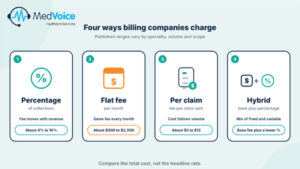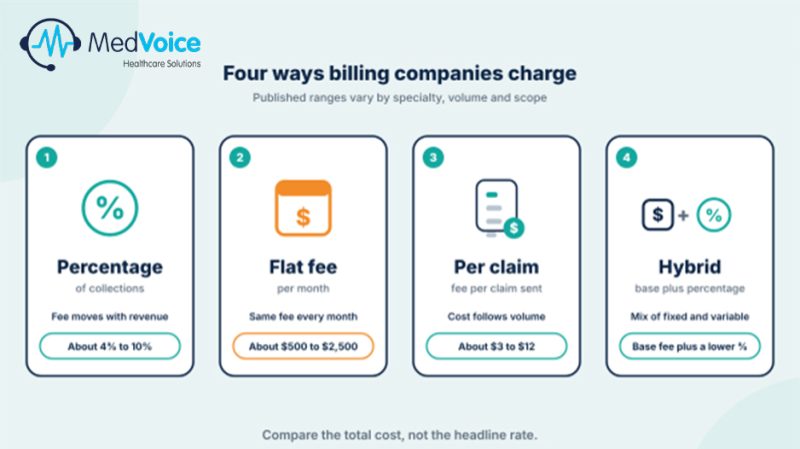
Medical billing services cost is usually set as a percentage of collections, commonly quoted from about 4% to 10%, or as a flat monthly fee of roughly $500 to $2,500. Per-claim and hybrid models also exist. Published ranges vary by specialty, volume and scope, so compare the total cost, not the headline rate.
The Quote Is Not the Cost
One billing company quotes 5% of collections. Another quotes $2,000 a month. A third says 4% plus setup, software and a fee for every appeal. Which one is cheaper? You cannot tell from the headline number.
Medical billing services cost depends on the pricing model, what is included and how well the company collects. MedVoice pricing starts as low as 3% with no hidden fees, and a denial rate of less than 3% keeps rework from eating your margin. This guide breaks down medical billing company fees, compares percentage vs flat fee billing and shows how to find your true cost.
Figure 1: Four common pricing models behind medical billing services cost, with ranges that vary by practice.
Key takeaways
- Medical billing services cost is most often a percentage of collections or a flat monthly fee.
- Percentage vs flat fee billing is a trade-off between alignment and predictability.
- Medical billing company fees often include extras such as setup, software and denial rework.
- Convert every quote to an effective rate before you compare.
- Results matter as much as price, because a cheap fee on weak collections costs more.
How Much Do Medical Billing Services Cost?
Medical billing services cost is most often a percentage of collections, commonly quoted from about 4% to 10%, or a flat monthly fee of roughly $500 to $2,500. Some companies charge per claim or mix a base fee with a percentage. Ranges vary by specialty, volume and services included.
| Model | Typical published range | Often suits |
| Percentage of collections | About 4% to 10% | Practices that want fees tied to results |
| Flat monthly fee | About $500 to $2,500 per month | Steady, higher-volume practices |
| Per claim | About $3 to $12 per claim | Steady volume and simple claims |
| Hybrid | Base fee plus a lower percentage | Growing practices that want some predictability |
These ranges come from vendor-published guides and are unverified estimates. Your quote will vary by specialty, volume, payer mix and scope.
Percentage vs Flat Fee Billing: Which Is Better?
Percentage vs flat fee billing comes down to alignment versus predictability. A percentage fee rises and falls with your collections, so the company earns more when you do. A flat fee stays the same, which helps budgeting but can hide weak performance. Neither is better for every practice.
| Factor | Percentage of collections | Flat monthly fee |
| Cost behavior | Moves with revenue | Same each month |
| Incentive | Company earns more when you collect more | Company is paid whether or not collections rise |
| Budgeting | Varies month to month | Easy to predict |
| Risk | Costs grow as collections grow | Can cost more in slow months |
| Watch for | Fees on gross vs net collections | What the fee leaves out |
Many practices find percentage vs flat fee billing easier to judge once they run the numbers on their own collections.
How Does Percentage vs Flat Fee Billing Compare in Real Life?
A 5% fee and a $2,000 flat fee cost the same at $40,000 in monthly collections. Below that, the percentage costs less. Above it, the flat fee costs less. This is an illustration only, so run the same math on your own collections and your own quotes.
| Monthly collections | 5% of collections | $2,000 flat fee |
| $40,000 | $2,000 | $2,000 |
| $100,000 | $5,000 | $2,000 |
| $200,000 | $10,000 | $2,000 |
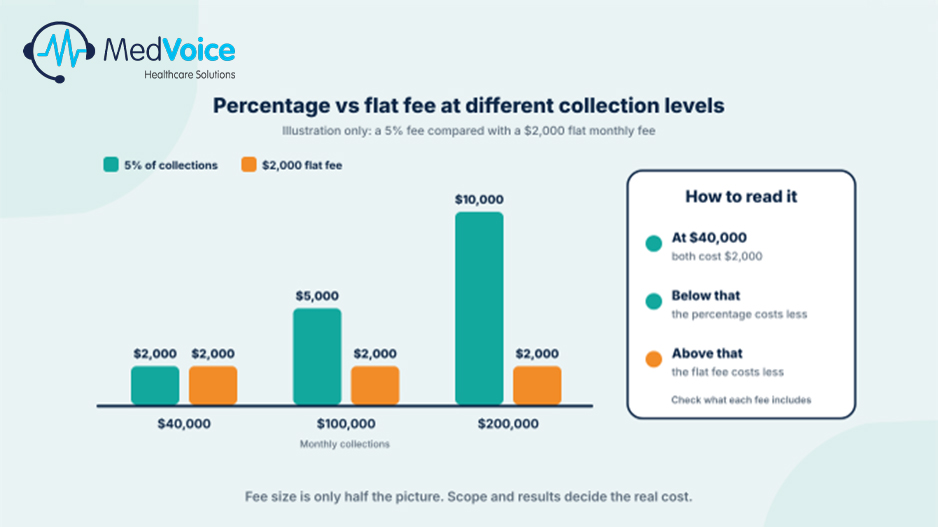
Figure 2: Where percentage vs flat fee billing crosses over (illustration only).
The cheaper fee is not always the better deal. A flat fee that excludes denial work can cost more once appeals are billed on top.
What Do Medical Billing Company Fees Include Beyond the Quoted Rate?
Medical billing company fees can include more than the quoted rate: setup or onboarding, software or EHR access, clearinghouse charges, credentialing, paper statements, denial rework and appeals, minimums and termination terms. Ask for an itemized schedule so you can see the real medical billing services cost.
- Setup and onboarding: a one-time charge some companies add.
- Software and EHR: access or integration billed monthly.
- Clearinghouse: per-claim, eligibility or remittance fees.
- Credentialing: often billed per provider and payer.
- Denial rework and appeals: sometimes billed separately or left out.
- Contract terms: minimum fees, annual increases and termination penalties.
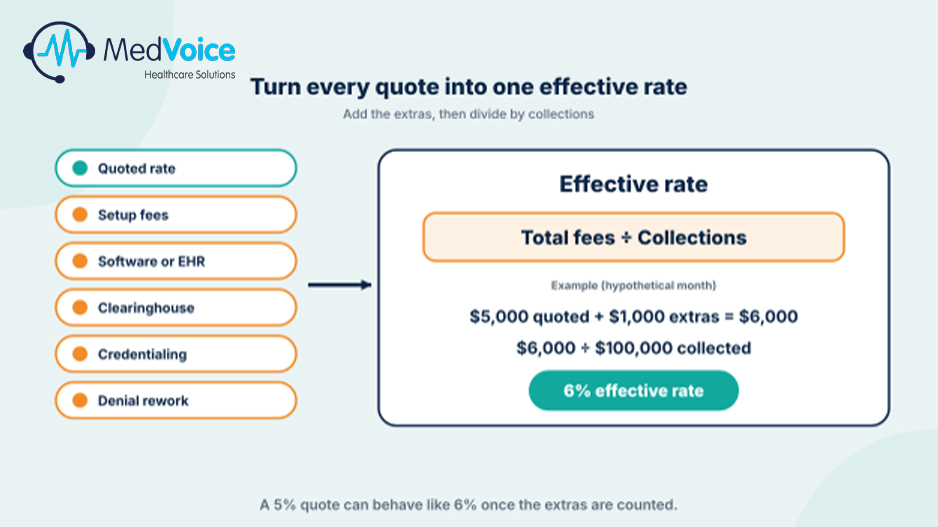
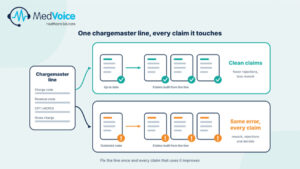
Figure 3: Turn every quote into one effective rate before you compare medical billing services cost.
Want an itemized view of your medical billing services cost? MedVoice offers a free revenue audit of your billing workflow, collections and denial patterns. Request a free revenue audit today.
What Factors Change Medical Billing Services Cost?
Medical billing services cost changes with specialty complexity, claim volume, payer mix, the scope of services and the technology used. A coding-only service costs less than full revenue cycle management. Higher volume often earns a lower percentage, and complex specialties often cost more to bill.
- Specialty: prior authorizations, modifiers and denial rates raise the work.
- Volume: larger practices often negotiate lower rates.
- Scope: claim submission only, or full revenue cycle management.
- Technology: automation and claim scrubbing can add cost but may lift first-pass results.
Rates and rules vary by payer and state.
What Is Cost to Collect, and Why Does It Matter?
Cost to collect is your total billing cost divided by what you collect. It shows whether medical billing services cost is worth it, because a low fee on weak collections can cost more than a higher fee on strong ones. Track it before and after you change vendors, and include every fee and every hour of staff time.
Two companies can quote the same rate and deliver very different results. Clean claims, low denials and fast follow-up decide how much of what you earn reaches your account. That is why medical billing company fees should be weighed against results, not on their own.
Ask each company how it reports collections, denials and A/R days. That visibility lets you check medical billing company fees against real results.
Which Questions Should You Ask Before You Compare Medical Billing Company Fees?
Before you compare medical billing company fees, ask what the price includes, how denied claims are billed, whether setup or software fees apply, how long the contract runs and how results are reported. Clear answers show the true medical billing services cost and how a company handles your money.
| Question | Why it matters |
| Is denial management included? | Appeals billed separately can raise your effective rate |
| Are there setup, software or clearinghouse fees? | Extras can add to the quoted rate |
| How is the fee calculated? | Gross vs net collections changes the bill |
| What are the contract and exit terms? | Long terms and penalties limit your options |
| How often do you report, and what is in it? | You need collection, denial and A/R visibility |
| Who owns the data and software? | You should be able to leave with your records |
How Does MedVoice Price Its Medical Billing Services?
MedVoice keeps medical billing services cost transparent: pricing starts as low as 3% and is typically a percentage of collections, so MedVoice earns more when you collect more. There are no hidden fees. Free AI scribing and coding tools and free EHR and practice management software come with billing services.
- Transparent pricing starting as low as 3%
- No setup fees and no hidden fees
- Free AI scribing and coding tools included with billing
- Free EHR and practice management software
Practices that switch also look at results: MedVoice reports a 15% increase in revenue collection and handles denials through its denial management services. See the full picture on our medical billing services page.
Related reading: the ROI of outsourcing medical billing, billing strategies for independent practices and how AI supports clean claims and lower A/R days.
Where Should You Start When Comparing Medical Billing Services Cost?
Start with three steps: pull your last three months of collections, ask each company for an itemized fee schedule and convert every quote to an effective rate. That shows the real medical billing services cost, and it makes percentage vs flat fee billing a math problem instead of a guess.
You do not need to guess your way to the right model. Run the numbers, check what is included and weigh results alongside price. MedVoice can walk through your collections and show your medical billing services cost.
Want to see your true billing cost? Start with a free revenue audit or schedule a consultation. Schedule a Consult or call 972-755-5474.
Email: sales@medvoiceinc.com | Phone: 972-755-5474 | Toll free: 855-215-5906
Frequently Asked Questions
What is a typical percentage for medical billing company fees?
Published guides commonly quote about 4% to 10% of collections, with many small and mid-size practice quotes landing between roughly 5% and 8%. Specialty, volume and services included all move the rate. Treat these as estimates and ask for an itemized quote. MedVoice pricing starts as low as 3%.
In percentage vs flat fee billing, is the flat fee cheaper?
It can be when collections are high and steady, because the fee stays the same as revenue grows. It can cost more when collections are low or seasonal. Check what the flat fee includes, such as denial work and appeals, and compare it with a percentage quote on the same collections.
Do medical billing company fees include setup charges?
Some do, and some also charge for credentialing, software, clearinghouse use or denial rework. Published guides list one-time setup charges, but amounts vary widely and are unverified. Ask for an itemized fee schedule before you sign. MedVoice lists no setup fees and no hidden fees.
How do I compare quotes from two billing companies?
Convert each quote to an effective rate: total fees for a period divided by collections for that period. Include setup, software, clearinghouse, credentialing and denial work, so you compare medical billing company fees on equal terms. Then compare reporting, contract length and exit terms, plus clean claim and denial results. The lowest headline rate is not always the lowest cost.
Does outsourcing cut medical billing services cost?
It can, when the fee is lower than the in-house cost of staff, software and rework, and when collections hold or improve. Compare cost to collect, meaning total billing cost divided by collections, before and after. Results vary by practice, payer mix and the scope of services.
This article is for general information. Pricing varies by company, specialty, volume and scope, and the ranges here are published estimates. Request a written, itemized quote and review contract terms with your advisor.
Sources
OmniMD, How Much Does Medical Billing Cost? Prices, Models, and Hidden Fees (pricing models, per-claim and flat-fee ranges, hidden fees, vendor questions)
Neolytix, What Is the Going Rate for Medical Billing Services? (percentage range, price drivers, add-on fees)
MedCare MSO, Outsourcing Medical Billing: Cost vs ROI (model comparison, add-on costs, cost-to-collect method)
All three sources are billing vendor guides. Their ranges are unsourced estimates, so use them as a rough guide only.