Last updated: November 2026 | Author: Market Kapchur
To switch medical billing companies without losing revenue, audit your current numbers, read the termination terms, sign a new HIPAA business associate agreement, collect your claims data, update payer remittance details, and run both teams in parallel for a short overlap. Assign owners to every open claim so nothing falls through the gap.
You Know It Is Time. You Are Afraid of the Gap
Denials keep coming back for the same reasons. Reports arrive late, if at all. You have asked twice about a batch of old claims and still have no answer. Part of you knows it is time to switch medical billing companies, and part of you is afraid of the payment gap a bad handoff can create.
That fear is fair, and it is manageable. A medical billing transition goes wrong when nobody owns the open claims, the payer details are not updated, or the data never comes back. Each of those is a checklist item, not a mystery.
Here is how to decide, how to plan and how to hand off, step by step. It is written for practice owners and office managers who want to change medical billing company partners without stalling cash flow.
| Key Takeaways Use numbers to confirm the signs you need a new billing company. Denial rate, A/R days and clean claim rate show whether the problem is your vendor or something else. Read your contract first. Notice periods, fees and data return terms decide your timeline. Sign a new BAA before any PHI moves. HIPAA expects a written agreement, and the old company must return or destroy PHI at termination where feasible. Plan an overlap when you switch medical billing companies. A short parallel run keeps claims moving while payers update remittance details. Own every open claim. Decide who works what, and by when, before the switch date. |
|---|
What Are the Signs You Need a New Billing Company?
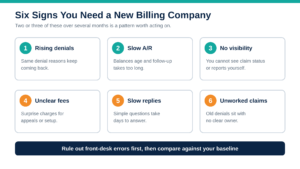
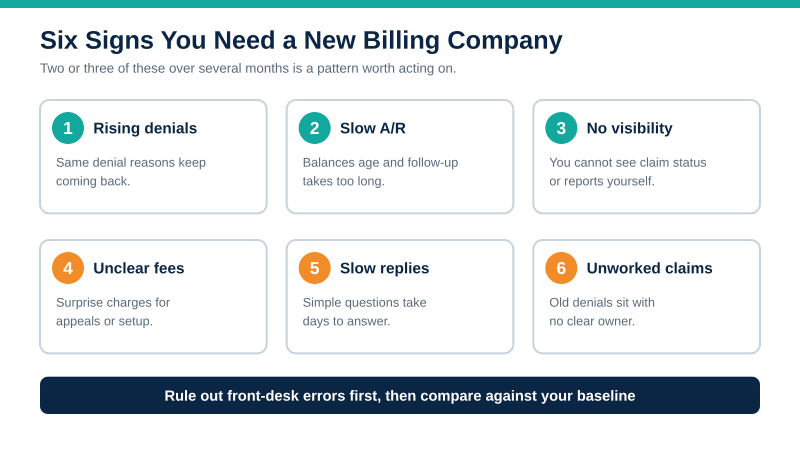
The clearest signs you need a new billing company are rising denials, slow A/R, missing or late reports, unclear fees, slow replies and old claims nobody works. One bad month is noise. A steady pattern across two or three of these is a reason to start evaluating a change.
- Rising denials. Repeat denials for the same reason mean the root cause is not being fixed.
- Slow A/R. Aging balances and long waits suggest weak follow-up.
- No visibility. If you cannot see claim status or reports on your own, you are guessing.
- Unclear fees. Surprise charges for appeals, setup or software are a red flag.
- Slow communication. Questions that take days to answer cost you money while you wait.
- Staff doing rework. If your team keeps fixing their errors, you are paying twice.
Before you blame the vendor, rule out front-desk errors such as eligibility and registration problems. If the errors come from your side, they will follow you when you switch medical billing companies.
What Should You Do Before You Change Medical Billing Company?
Before you change medical billing company, capture a baseline, read the contract, list every open claim and confirm who owns your data. Baseline numbers show whether the switch worked. The contract sets notice periods and exit terms. A clear open-claims list prevents revenue from vanishing during the handoff.
| Pre-switch task | What to capture |
|---|---|
| Baseline metrics | Denial rate, A/R days, clean claim rate, monthly collections |
| Contract review | Notice period, termination fees, data return terms, who owns the claim data |
| Open claims inventory | Unbilled charges, pending claims, denials in appeal, aging buckets |
| Access list | Clearinghouse, payer portals, practice management and EHR logins |
| Decision owner | One person at the practice who runs the transition |
Not sure whether the problem is your vendor or your process? A second opinion helps. See how MedVoice medical billing services approach audits, then compare notes with your own numbers.
How Does a Medical Billing Transition Work, Step by Step?
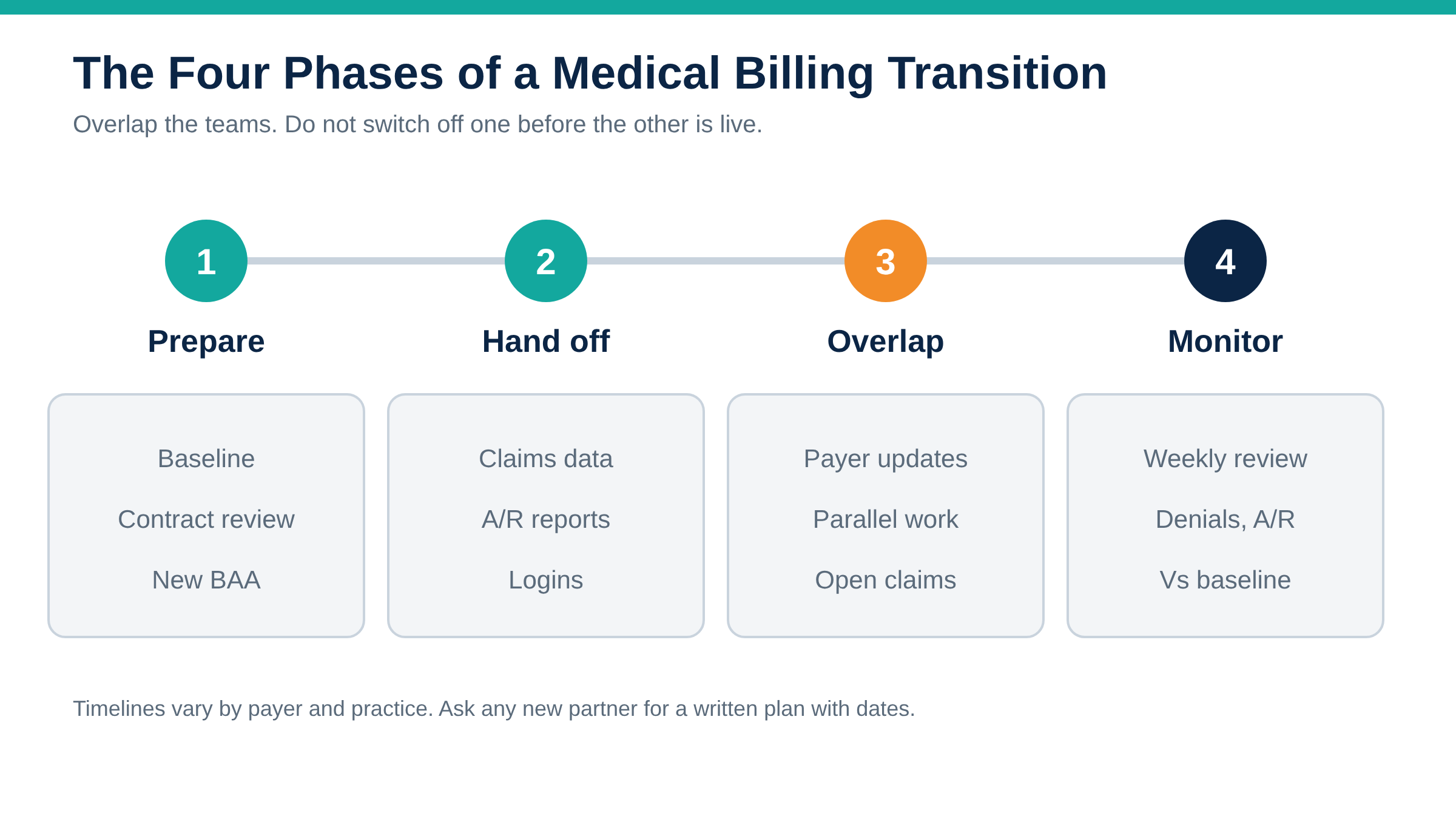
A medical billing transition runs in four phases: prepare, hand off, overlap and monitor. Prepare means baseline, contract and BAA. Hand off means data and access. Overlap means both teams share work while payers update details. Monitor means tracking results against your baseline until the new process is stable.
| Phase | What happens | Your part |
|---|---|---|
| 1. Prepare | Baseline, contract review, new BAA, kickoff plan | Name an owner, share goals |
| 2. Hand off | Claims history, A/R reports, fee schedules and logins move over | Request files, grant access |
| 3. Overlap | Payer remit-to and EFT/ERA updates, parallel claim work | Approve payer updates |
| 4. Monitor | Weekly review of denials, A/R and collections | Compare to baseline |
Timelines vary by payer and practice size, so ask any new partner for a written plan with dates. Be wary of promises that skip the overlap.
What Data and Access Should You Get From Your Old Billing Company?
Ask for A/R aging reports, claims and payment history, denial and appeal logs, payer and fee schedule details, patient demographics and payer enrollment information. Request it in a usable format early, and put the request in writing. Data you do not have in hand cannot be reconciled later.
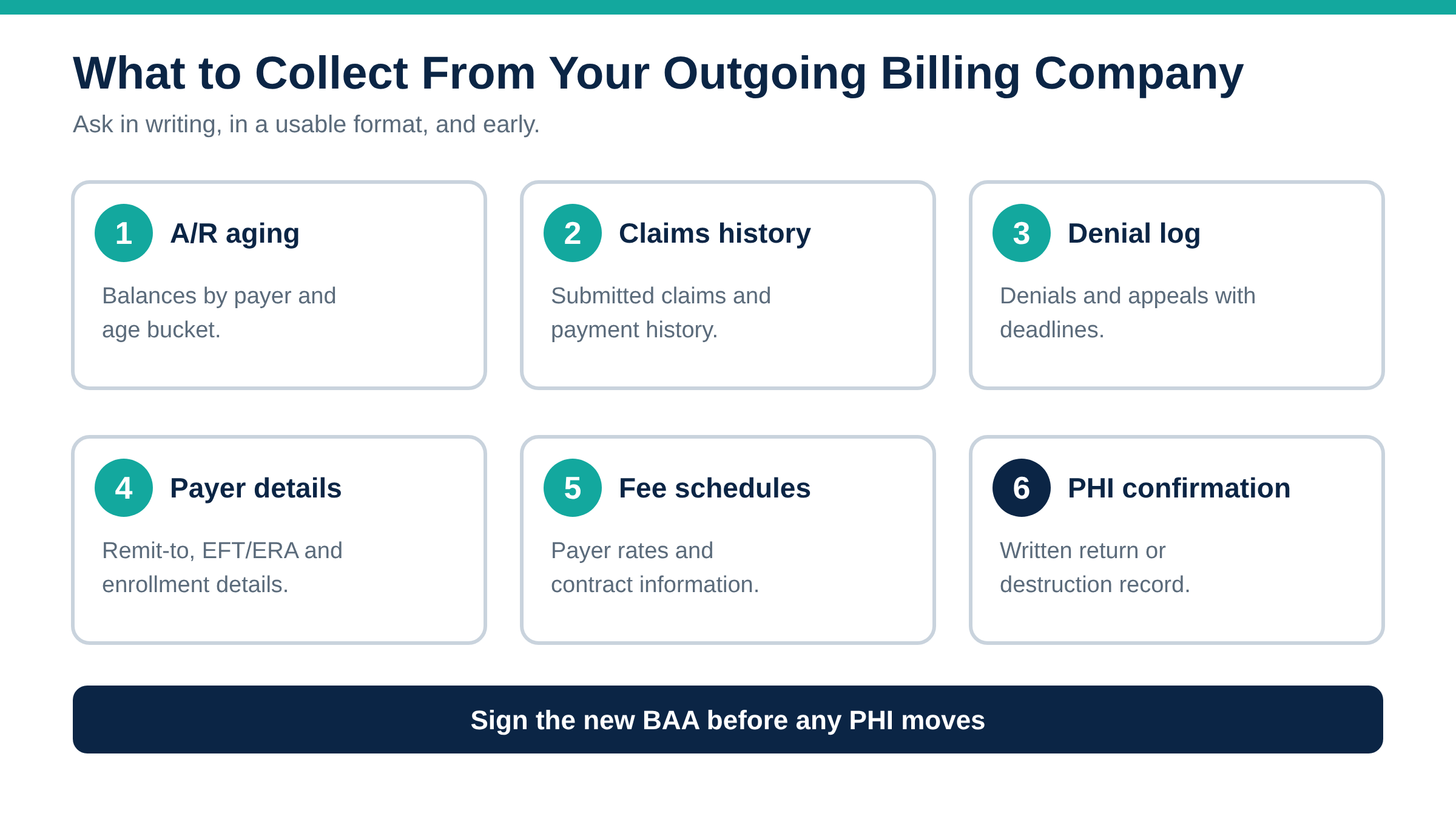
HIPAA matters here. A covered entity generally needs a written business associate agreement before a billing company handles PHI, so sign one with your new partner first. HHS also says a BAA must require the business associate to return or destroy PHI at termination where feasible. Ask the old company to confirm in writing what was returned and what was destroyed.
Do not forget payer logistics. Payers require updates when remit-to, bank or billing details change, and some let an authorized billing vendor submit those changes on your behalf. Missing this step is how payments get sent to the wrong place.
What Goes Wrong in a Medical Billing Transition?
Most transitions fail on ownership, not skill. Open claims fall between two teams, payments go to old accounts, and denials age while everyone assumes someone else has them. Medicare generally requires claims within 12 months of service, and commercial limits vary, so unowned work can quietly expire.
- Orphaned A/R. Decide which team works pre-switch claims and put it in writing.
- Misrouted payments. Confirm every payer has the right remit-to and EFT/ERA details.
- Duplicate submissions. Set a clear cutover date for who bills what.
- Denials left sitting. Hand over the appeal log with deadlines, not just a spreadsheet.
- Staff confusion. Tell front-desk and clinical teams who to call for what.
Strong denial management is the best safety net during a switch, because it catches problems before they age. MedVoice clients see a 40% reduction in A/R days, and tracking denials by root cause from day one is part of how.
How Do You Choose the Right New Partner Before You Switch Medical Billing Companies?
Before you switch medical billing companies, ask any candidate for transparent pricing, a written transition plan, HIPAA compliance, named contacts and live reporting access. Check coding accuracy and denial results, and talk to practices like yours. A good partner explains the process plainly and does not skip the overlap.
- Results you can verify. MedVoice reports a 98% clean claim submission rate and a denial rate under 3%. Ask every vendor for comparable figures and how they measure them.
- Pricing in plain terms. Our guide to billing service pricing explains percentage and flat-fee models.
- Full revenue cycle support. If billing is only part of the gap, look at revenue cycle management as a whole.
- Your size and specialty. Independent practices have different needs, as our independent practice playbook explains.
- Payment posting discipline. Underpayments hide in remittances, so ask how payment posting is handled.
Conclusion: Switch Medical Billing Companies on Your Terms
You can switch medical billing companies without a revenue gap if you plan it. Capture a baseline, read the contract, sign a new BAA, collect your data, update payers and overlap the teams. Then track results weekly. The practices that struggle are usually the ones that skip the plan.
| Thinking about a change? Start with a free revenue audit Talk to MedVoice about your current denials, A/R and reporting. We will review your numbers with you and map out a transition plan with no pressure. Schedule a free consult Call 972-755-5474 | Toll free 855-215-5906 | sales@medvoiceinc.com |
|---|
Frequently Asked Questions
How long does it take to switch medical billing companies?
It depends on your size, specialty, payer mix and how quickly data and payer updates move. Plan for an overlap period rather than a hard cutoff, and ask the new company for a written timeline with dates. Payer enrollment changes in particular can take longer than expected.
Will I lose money if I change my medical billing company?
Not if the handoff is planned. Losses usually come from unowned open claims, misrouted payments and expired filing windows. Capture a baseline, assign ownership of every open claim and monitor weekly. Expect some disruption, and measure it against your baseline so you can spot problems early.
Who owns my claims data when I leave?
Your practice does. Under HIPAA, a business associate agreement must require return or destruction of PHI at termination where feasible. Review your contract for data return terms and fees before you give notice, and ask for a written confirmation of what was returned or destroyed.
What happens to claims already submitted to payers?
They stay in the payers’ systems and still need follow-up. Decide in writing whether your old company, the new one or your staff works those claims, and set a date. Keep the denial and appeal log in view, because payers have filing and appeal deadlines.
Should I switch medical billing companies in the middle of the year?
You can. A clean start at the beginning of a month makes reporting easier, but waiting for a perfect date can cost you more than the switch. Move when your numbers show a clear pattern. Check contract notice periods and payer deadlines first.
Sources
- HHS, Do the HIPAA Rules require a CSP to maintain ePHI after services end? (FAQ 2082). A BAA must require return or destruction of PHI at termination where feasible (45 CFR 164.504(e)(2)(ii)(J)).
- HHS, Sample Business Associate Agreement Provisions. Required elements of a written business associate contract.
- BlueCross BlueShield of Tennessee, EFT and ERA Provider FAQ. Bank changes go through payer enrollment, and a billing vendor can submit changes for a provider.
- Cigna, Electronic Payment and Remittance Advice. Changes to TIN, billing address or bank account require a submitted change.
- CMS, Medicare Claims Processing Manual Timely Filing Update. Medicare 12-month filing limit from date of service.