Last updated: November 2026 | Author: Market Kapchur
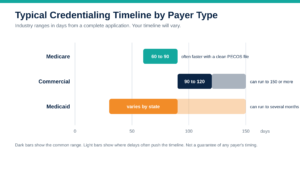
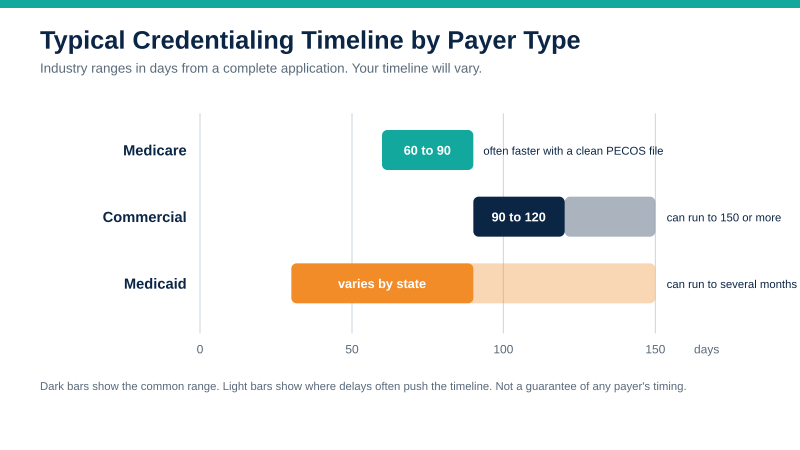
How long does medical credentialing take? Usually 60 to 120 days from a complete application. Medicare often lands around 60 to 90 days, commercial payers commonly take 90 to 120 days and sometimes longer, and Medicaid depends on your state. Missing documents and a stale CAQH profile cause most of the delay you can control.
Your New Provider Is on the Schedule, but Cannot Bill Yet
The new physician starts Monday. The exam rooms are ready and the schedule is full. Then billing asks the question nobody wanted to hear: are we credentialed with the payers yet?
If the answer is no, every visit becomes a claim that can be denied, held or paid late. That is why how long does medical credentialing take is a question to answer before the offer letter is signed, not after.
The honest answer is a range, not a date. Most payers need two to four months, a few need longer, and the biggest swing factor is how clean your application is when it lands. This guide covers the real payer enrollment timeline, the credentialing delays that stretch it, and the fixes that shorten it.
| Key Takeaways How long does medical credentialing take? Plan for 60 to 120 days. Commercial payers can run to 150 days or more. Medicare is often the quickest large payer. But your effective date depends on when you file, not when you are approved. You control more than you think. Incomplete files and a lapsed CAQH attestation are the top credentialing delays you can fix. Start early. Begin new provider credentialing 90 to 120 days before the first visit, and track the payer enrollment timeline for each payer. Routine beats heroics. A simple tracking habit beats frantic follow-up calls at the end. |
|---|
How Long Does Medical Credentialing Take by Payer?
Most providers wait 60 to 120 days. Medicare often takes 60 to 90 days from a complete application, commercial payers commonly take 90 to 120 days and some run to 150 days or more, and Medicaid timing depends on your state. Hospital privileging is separate and adds its own steps.
These are industry ranges, not promises from any payer. Use them as your payer enrollment timeline starting point, then confirm with each payer. Specifics vary by payer and state.
| Payer type | Typical range | What drives the timing |
|---|---|---|
| Medicare | 60 to 90 days | Complete PECOS application, correct enrollment form, regional contractor workload |
| Commercial payers | 90 to 120 days, sometimes 150 or more | CAQH completeness, payer committee schedule, contract steps |
| Medicaid | Varies by state | State enrollment rules, state portal and review queue |
The clock starts when the payer has a complete application, not the day you mail it. Missing information pushes the date back.
What Is the Payer Enrollment Timeline, Step by Step?
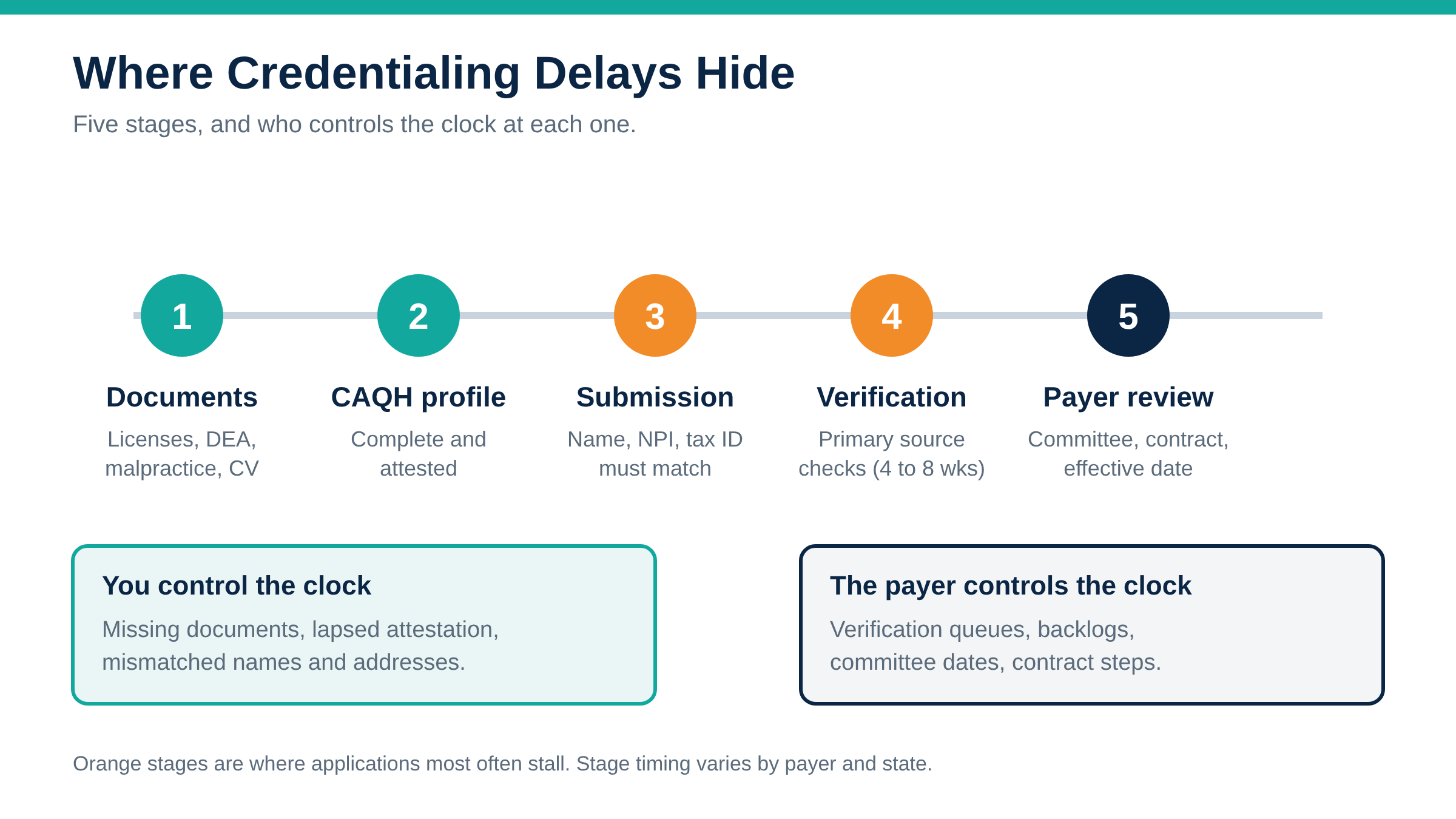
The payer enrollment timeline has five stages: gather documents, complete and attest your CAQH profile, submit applications, wait through primary source verification, then payer review and contracting. You control the first three. Verification alone often takes 4 to 8 weeks because every credential is confirmed with its original source.
| Stage | Who controls it | What happens | Typical pace |
|---|---|---|---|
| 1. Documents | You | License, DEA, board certification, malpractice history, CV and work history | Days to weeks, depending on how organized you are |
| 2. CAQH profile | You | Profile completed and attested so payers can pull your data | A few days when documents are ready |
| 3. Submission | You or your credentialing team | Applications go to each payer with matching name, NPI and tax ID | As soon as the file is clean |
| 4. Verification | Payer or its verifier | Education, licensure, board status and malpractice confirmed at the source | 4 to 8 weeks |
| 5. Payer review | Payer | Committee review, contract and effective date | Weeks, varies by payer |
Why Do Credentialing Delays Happen?
Credentialing delays usually come from incomplete applications, mismatched provider details, a lapsed CAQH attestation, slow primary source verification and payer backlogs. The first three are fixable on your side. The last two are not, which is why clean submissions and steady follow-up matter.
- Incomplete applications. A missing malpractice certificate or an unexplained work history gap sends the file back to the start of the queue.
- Mismatched details. The legal name, address and tax ID need to match across NPI, IRS and payer forms. Even a missing name suffix can trigger a rejection.
- Lapsed CAQH attestation. CAQH requires re-attestation at least every 120 days. If it lapses, payers cannot pull your data, and the enrollment can stall.
- Slow verification. Licensing boards, schools and past employers answer on their own schedule, which is why this is often the slowest phase.
- Payer backlogs and committee dates. Many payers review files at set committee meetings, so a file that just misses a cut-off waits for the next one.
- No owner for follow-up. Applications sit when nobody is assigned to chase them.
Credentialing delays and authorization delays share one root problem: admin work with no clear owner. See how that plays out on the claims side in our guide to prior authorization in medical billing.
Not sure where your applications are stuck? MedVoice can review your credentialing status and point out the delays you can fix. Ask for a free revenue audit or a quick consult.
How Does New Provider Credentialing Affect Revenue?
New provider credentialing affects revenue because visits can be unbillable or paid late until enrollment is effective. Medicare sets your effective date from your filing date and may allow billing up to 30 days earlier when requirements are met. Commercial payers set their own rules, so do not assume they will pay for earlier visits.
- Idle capacity. A hired but unenrolled provider sees fewer insured patients or generates claims that cannot be paid yet.
- Medicare effective dates. The effective date is the later of your filing date or the date you started seeing patients at the location. Retroactive billing is limited to 30 days (42 CFR 424.520 and 424.521).
- Held claims. Some payers release held claims after approval, but timely filing limits still apply. Check each payer first.
Here is a quick way to size the problem for your next hire: daily lost revenue = visits per day x average collection per visit x days waiting. Run it before the start date, not after.
Credentialing is the front door of your revenue cycle management. A provider loaded correctly with each payer supports a clean claim from the first visit, and MedVoice reports a 98% clean claim submission rate. Independent practices feel this most, which is why our independent practice playbook puts enrollment near the top of the checklist.
How Can You Fix Credentialing Delays and Speed Up Enrollment?
Fix credentialing delays and shorten your payer enrollment timeline by starting 90 to 120 days early, building one complete document file, attesting CAQH before you apply, matching every detail, applying to payers in parallel, and following up on a fixed schedule.
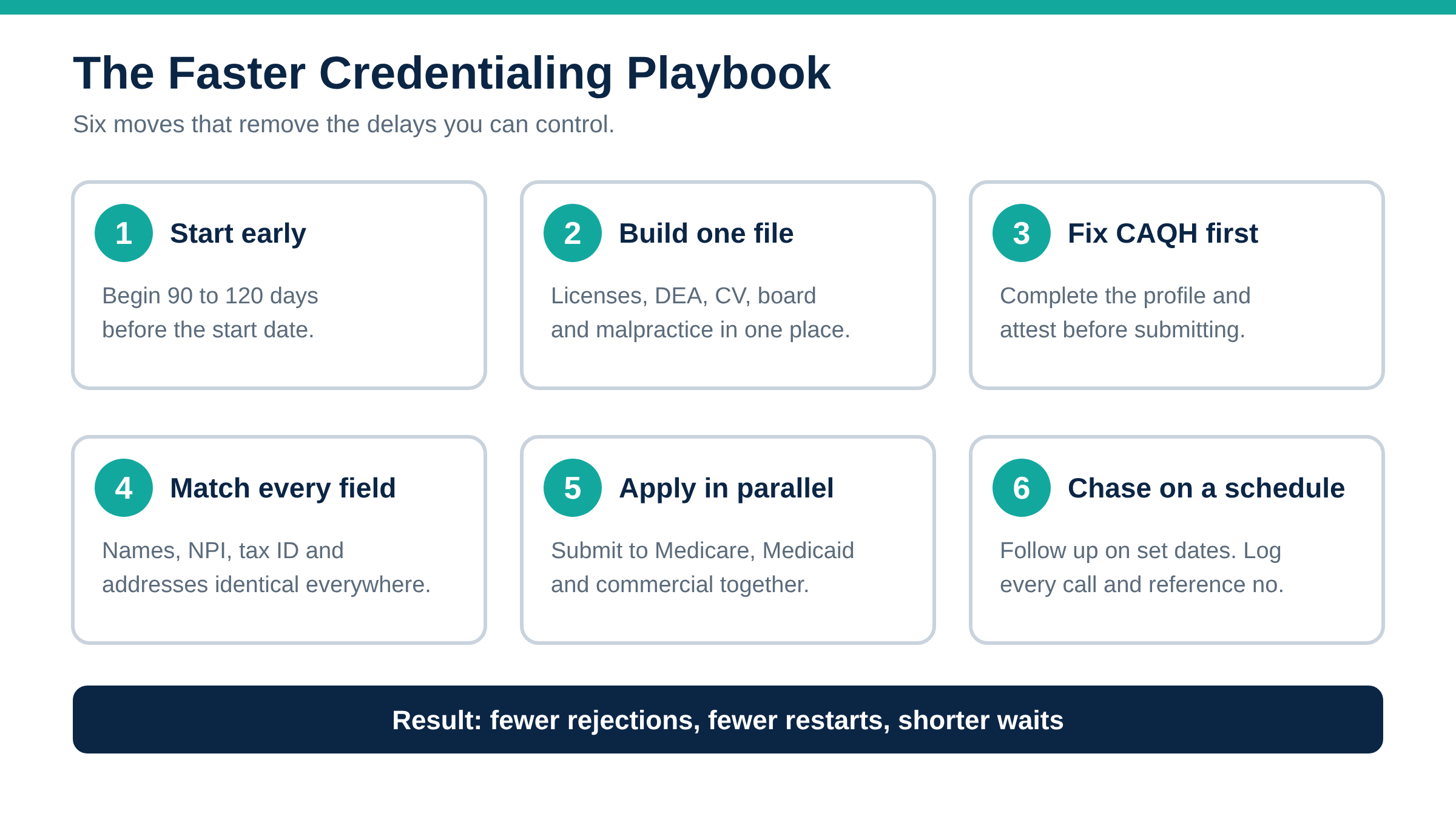
- Start 90 to 120 days early. Build the buffer into every hiring plan, and add more for new provider credentialing at hospitals or many payers at once.
- Build one master file. Keep licenses, DEA, CV, board certification and malpractice documents in one place, current and readable.
- Fix CAQH before you apply. Complete the profile, attest it, and set reminders for the 120-day cycle. A quarterly review keeps you ahead of it.
- Match every field. Compare names, addresses, NPI and tax ID across every form before anything is submitted.
- Apply in parallel. Send Medicare, Medicaid and commercial applications together, then track each payer on its own clock.
- Use PECOS online for Medicare. Online submission tends to reduce errors compared with paper, and you can track status.
- Follow up on set dates. Log every call with a reference number and the reviewer’s name, and escalate when a payer passes its own stated window.
AI tools can help flag missing fields and expiring documents, but they provide suggestions for human review. A person should confirm every application before it goes out.
Which Credentialing Clocks Keep Running After Approval?
Approval is not the finish line. CAQH needs re-attestation at least every 120 days, payers that follow NCQA standards recredential providers about every 36 months, and Medicare enrollment is generally revalidated about every five years. Miss one clock and payments can pause or network status can be at risk.
- CAQH: re-attest at least every 120 days, even when nothing changed.
- NCQA recredentialing: about every 36 months, so start the file 90 to 120 days early.
- Medicare revalidation: generally every five years for most provider types (42 CFR 424.515).
NCQA’s verification time limit is also tighter: 120 calendar days for files processed on or after July 1, 2025, down from 180. Rules differ by payer and state, so confirm each one.
Should You Outsource Medical Credentialing?
Outsourcing makes sense when nobody in your office owns credentialing, you are adding providers or payers, or applications keep stalling. A dedicated team handles new provider credentialing end to end, submits clean files, tracks every payer and keeps CAQH current, so providers can start billing sooner.
MedVoice’s medical credentialing services cover enrollment with insurance networks, hospitals, Medicare, Medicaid and specialty networks, plus ongoing re-credentialing, expiration tracking and license renewals. Nationwide, with payer expertise state by state.
Because the same team also handles medical billing services, credentialing connects directly to clean claims. MedVoice reports a 40% reduction in A/R days and a 15% increase in revenue collection, and AI billing and scribing tools come free with billing services. Pricing is transparent, starting as low as 3%. See how percentage and flat-fee models compare in our medical billing cost guide.
Conclusion: Plan for Months and Start Now
So, how long does medical credentialing take? Plan on 60 to 120 days, start 90 to 120 days before the start date, and treat CAQH, matching details and scheduled follow-up as your biggest levers. The sooner a clean application is filed, the sooner the provider can bill.
| Get your providers billing faster Book a free revenue audit or schedule a consult with MedVoice. We will review where your applications stand and what is slowing them down. Schedule your free consult Call 972-755-5474 | Toll free 855-215-5906 | sales@medvoiceinc.com |
|---|
Frequently Asked Questions
How early should I start new provider credentialing?
Start 90 to 120 days before the provider’s first scheduled patient visit. That window covers document gathering, CAQH setup, verification and payer review for most payers. Hospital privileging or many payers at once may need even more lead time.
Can a provider see patients while credentialing is pending?
Scheduling is your decision, but billing is the risk. Medicare may allow billing up to 30 days before the effective date when requirements are met. Commercial payers set their own rules, so check each contract before booking insured patients, and track held claims carefully.
What is the difference between credentialing and payer enrollment?
Credentialing verifies a provider’s qualifications, such as license, education, board status and malpractice history. Payer enrollment registers the provider with a specific payer so claims can be paid. They run together in practice, and a payer decision plus contract is what makes a provider billable.
Can I apply to multiple payers at the same time?
Yes, and you should. Running Medicare, Medicaid and commercial applications in parallel prevents months of avoidable waiting. Keep one master file and one CAQH profile so details match everywhere, then track each payer separately because every payer decides on its own timeline.
What should I do if my application seems stuck?
Confirm the payer has a complete application and that your CAQH attestation is current. Then ask for the status, the reviewer’s name and the next committee date, and log the reference number. Repeat on a set schedule, and escalate when the payer passes its own stated window.
Sources
- Practolytics, How Long Does Medical Credentialing Take. Medicare 60 to 90 days and commercial 90 to 120 days ranges.
- Medwave, How Long Does Medical Credentialing Take (2024). Broader 90 to 150 day industry range for credentialing.
- DirectShifts, Provider Credentialing Timeline Guide (2026). Primary source verification as the slowest phase, 4 to 8 weeks.
- Medwave, PECOS 2.0 Medicare Enrollment (2025). Starting enrollment 90 to 120 days before the start date, and PECOS status tracking.
- HHS Departmental Appeals Board, Decision CR5932. Medicare effective date and 30 day retrospective billing under 42 CFR 424.520 and 424.521.
- NCQA, Policy Updates (March 30, 2026). 120 calendar day verification time limit for files processed on or after July 1, 2025.
- Anthem Provider News, Credentialing with CAQH ProView. CAQH attestation every 120 days so payers can access the profile.
- Carepatron, Recredentialing guide. NCQA 36 month recredentialing cycle alongside CAQH re-attestation.
- Carepatron, Provider Enrollment: Medicare and Medicaid. Applying to Medicare, Medicaid and commercial payers in parallel.
- Kaizen, Medicare Credentialing and PECOS (2026). Name and address matching with IRS records, and online PECOS submission.
- Credential OS, Recredentialing checklist. Medicare revalidation cycle under 42 CFR 424.515.