Before you outsource medical billing, ask how you will see every claim, denial and write-off, not only what the service costs. The right billing partner shows you where your money is every month, in numbers you can check yourself.
Here is why that matters. Cost shows up on an invoice. Lost revenue does not. A denied claim that nobody works, or a write-off nobody mentions, can go unnoticed for months, until it appears in a report you were never shown.
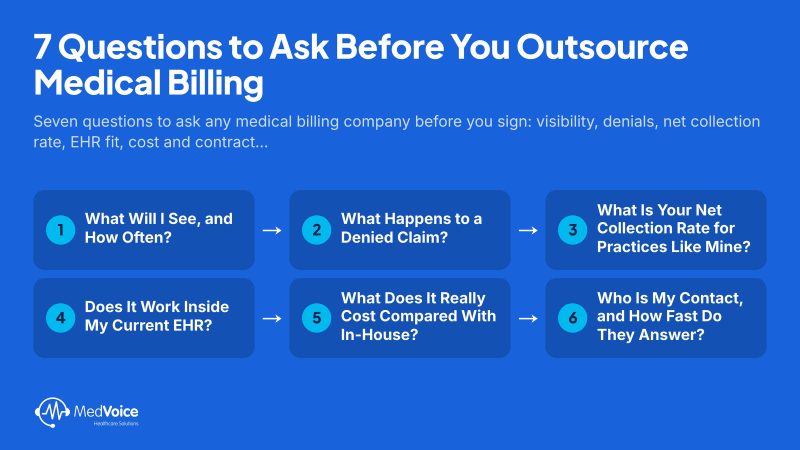
This guide gives you seven questions to ask any billing company, including us, before you sign. Each one tells you whether you will see your money or only hear about it.
1. What Will I See, and How Often?
Visibility is the question under every other question. Ask three things:
- Which reports do I get, and how often?
- Can I pull my own numbers between reviews?
- Will I see denials and write-offs, or only totals?
If the answer is "a monthly report", ask what happens in the rest of the month.
At MedVoice, practices get MedCOO, our real-time practice dashboard. It shows collections, denial percentage, claims by day and month, A/R (accounts receivable, the money owed to your practice), a credentialing monitor and self-run reports. You don’t wait for a PDF to learn what happened last Tuesday.
2. What Happens to a Denied Claim?
A denial is not lost money yet. It becomes lost money when nobody works it.
Ask the vendor to walk you through one denied claim, step by step. Who reviews it? Who writes the appeal? Who decides when a claim is written off, and will you be told?
Ask to see a sample denial report with all patient identifiers removed and verified.
MedVoice offers denial management, including appeals, along with monthly reporting and HIPAA-compliant processes. A Business Associate Agreement (BAA) is ready to send on request. Whichever vendor you talk to, us included, ask how it reports clean claim and denial rates, and which period each report covers.
3. What Is Your Net Collection Rate for Practices Like Mine?
Ask what net collection rate a biller delivers to comparable clients, and whether it has experience in your specialty. The two numbers answer different questions. Ask for both.
Then ask for the context: the specialty and the period behind each figure. A number without a period is a promise, not proof.
On specialty experience, ask for practices like yours. MedVoice works with small and mid-size practices across home health, mental health, family practice, cardiology, orthopedics, multi-specialty groups, ambulatory surgery centers and urgent care, and has served numerous practices over our 20+ years in business.
| Measure | What It Measures | What It Tells You |
|---|---|---|
| Clean Claim Rate | Claims accepted the first time they are sent | How well claims are built and checked before they go out |
| Net Collection Rate | How much of the money you are owed is actually collected | How well denials, appeals and follow-up are worked |
4. Does It Work Inside My Current EHR?
Changing systems costs your team time you don’t have. Ask whether the biller works inside the systems you already use (your EHR, or electronic health record, and your PM, or practice management, system), and whether access costs extra.
MedVoice works inside your existing EHR and PM system, with no extra fee for access. We work in eClinicalWorks, and our website lists experience with 50+ EHRs. If you use a different system, ask us on the first call.
5. What Does It Really Cost Compared With In-House?
Compare like with like. An in-house biller is a fixed cost whether claims are paid or not. An outsourced partner on a percentage of collections is paid when you are.
Add up your own in-house lines first: salary, benefits, software and training. That is your real baseline.
MedVoice prices full revenue cycle management (RCM) as a tailored percentage of your monthly collections, set once the scope is clear. Credentialing is $250 per provider per payer. Ask any vendor for its terms in writing before you compare.
| In-House Biller | Outsourced on a Percentage of Collections |
|---|---|
| Salary | One percentage of monthly collections |
| Benefits | Scope agreed up front |
| Billing software | Included in the agreed scope |
| Training and cover for leave and turnover | Handled by the partner’s team |
6. Who Is My Contact, and How Fast Do They Answer?
When a payer changes a rule or a batch of claims stalls, you need a person, not a ticket queue.
Ask who your named contact is and how quickly they reply. At MedVoice you get a dedicated account manager, email replies within one hour, and a phone line for urgent queries.
7. What Am I Signing, and How Do I Leave?
Read the exit before the entrance. Ask for the contract length, the notice period, and what happens to your data and reports if you leave.
Our terms are plain: a 12-month agreement with 90-day termination notice. A BAA is ready to send, so you can review it before any data is shared.
One more thing to ask every vendor: what results do you promise? The honest answer is none. Payers decide what gets paid. A good biller describes its work, shows you its figures with their source, and lets you check the rest in your own dashboard.
A Checklist to Take Into Every Call
- What will I see, and how often?
- What happens to a denied claim?
- What is your net collection rate for practices like mine?
- Do you work inside my current EHR?
- What does it cost compared with in-house?
- Who is my contact, and how fast do they reply?
- What am I signing, and how do I leave?
Print it. Ask every vendor the same seven questions. Write down the answers word for word, then compare.
See Your Real Number
You now have the questions. The next step is seeing your own answers.
Request a No-Cost Revenue Audit: available at no cost and with no obligation to eligible US medical practices. We confirm the scope on the kickoff call. Or call (972) 755-5474.
Frequently Asked Questions
What is a key risk when outsourcing medical billing?
Lack of visibility. Cost matters, but if you cannot see denials, write-offs and collections, problems can go unnoticed for months. Choose a partner that shows you these numbers as they happen.
Is a high clean claim rate enough?
No. It shows how claims go out, not how much money comes back. Ask for net collection rate too, with the period behind it.
Do I have to change my EHR to work with MedVoice?
No. MedVoice works inside your existing EHR and PM system, with no extra fee for access.
Can a billing company promise more revenue?
No one can promise payment: payers decide. MedVoice describes the work, including denial management and appeals, monthly reporting and HIPAA-compliant processes, with a Business Associate Agreement ready to send on request.
Where is MedVoice based?
MedVoice’s head office is in Dallas, Texas. We serve small and mid-size practices across the United States.