Navigating the financial complexities of an urgent care clinic can feel overwhelming. Without efficient processes, revenue can slip away, impacting your ability to provide patient care. This guide walks you through essential considerations for choosing the right urgent care medical billing services to maximize your revenue, reduce denials, and streamline operations.
Urgent care centers bridge the gap between primary care and emergency rooms, offering immediate treatment for non-life-threatening conditions. Their billing practices are unique, demanding specialized knowledge to ensure accurate claims and prompt reimbursement. This guide covers the critical aspects of urgent care medical billing, from coding essentials to best practices for improving your revenue cycle.
What Is Urgent Care Billing?

Precise procedural and diagnostic coding ensures prompt, accurate claim submissions.
Urgent care billing involves submitting claims for services provided in a walk-in clinic setting, typically for acute, non-emergent conditions. This process requires a precise understanding of coding guidelines and payer-specific rules to ensure accurate reimbursement for the services rendered.
Urgent care centers provide immediate care without appointments. They handle a wide range of conditions, from minor injuries to infections. Proper billing ensures these vital services are financially sustainable. MedVoice specializes in AI-powered billing solutions designed to improve cash flow and accuracy for practices like yours.
Urgent Care Billing vs. Emergency Room Billing
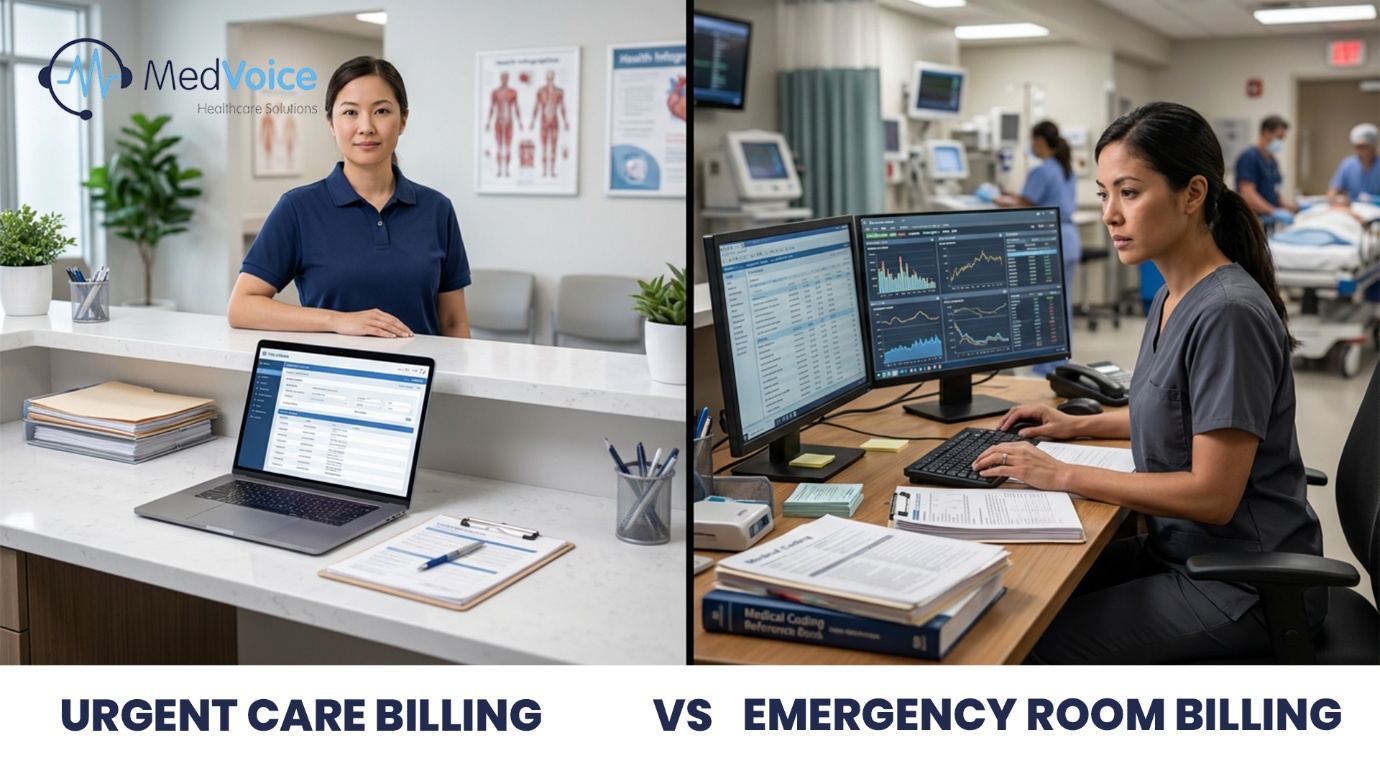
Urgent care billing differs significantly from emergency room (ER) billing in several key areas. These distinctions affect coding, reimbursement rates, and the patient’s out-of-pocket costs.
- Level of Acuity: Urgent care handles non-life-threatening conditions. ERs treat serious, life-threatening emergencies.
- Place of Service (POS): Urgent care uses POS code 20. ERs use POS code 23.
- Facility Fees: ERs often charge separate facility fees. Urgent care generally does not.
- Copayments: Urgent care copays are typically lower. ER copays are significantly higher.
- Coding Complexity: ER coding can be more complex due to higher severity. Urgent care coding focuses on acute, but less severe, conditions.
Understanding these differences is critical for accurate claim submission. Misclassifying an urgent care visit as an ER visit leads to denials and compliance issues. Our medical billing services for healthcare practices ensure your claims are always correctly categorized and coded.
Urgent Care Coding Essentials: CPT, ICD-10 & HCPCS S Codes
Selecting the right billing structure allows clinical staff to dedicate more focus to patient care.
Accurate coding is the backbone of successful urgent care billing. It requires precise application of Current Procedural Terminology (CPT), International Classification of Diseases, 10th Revision (ICD-10), and Healthcare Common Procedure Coding System (HCPCS) S Codes. These codes tell the payer what services were performed and why.
Mistakes in coding lead to claim denials and delayed payments. MedVoice uses AI to ensure super coding accuracy, minimizing human error. We maintain a 98% clean claim submission rate, translating to faster processing and consistent cash flow for your clinic.
E/M Codes for New vs. Established Patients (99202-99215)
Evaluation and Management (E/M) codes classify the complexity of patient visits based on medical decision making, the amount of data reviewed, and the time spent. New patients use codes 99202-99205, while established patients use codes 99211-99215.
These codes determine reimbursement levels for the physician’s cognitive work. Proper selection depends on the documented history and medical decision-making involved in the visit. MedVoice’s medical coding expertise ensures correct E/M level assignment, avoiding under-coding or over-coding risks. Johnny Blanchard, a private practice owner, praised our billing experience, noting MedVoice was “very responsive, knowledgeable and thorough in addressing my concerns.”
Common Procedure Codes (wound repair, I&D, foreign body removal, splinting)
Urgent care centers frequently perform minor procedures that require specific CPT codes. Examples include wound repair (e.g., 12001-12021), incision and drainage (I&D) of abscesses (e.g., 10060-10061), foreign body removal (e.g., 10120-10121), and splinting (e.g., 29105, 29125, 29515).
Each procedure has unique coding guidelines, including modifiers and documentation requirements. Accurate coding ensures appropriate reimbursement for these services. Our certified billing specialists have extensive experience with these common procedures across various specialties, including those handled in urgent care settings.
S9088 vs. S9083 Explained
HCPCS S codes are used by private payers to report services, supplies, and drugs not covered by CPT codes. Specifically, S9088 and S9083 denote facility services in urgent care settings.
- S9088: Typically indicates services for a “global fee urgent care facility.”
- S9083: Represents “global fee professional service.”
The distinction often lies in whether the code covers the facility component or the professional component of the visit. Payer contracts dictate which of these, if any, they accept and reimburse. Our team ensures your claims align with specific payer guidelines.
Modifier -25 and -59 Usage
Modifiers provide additional information about a service or procedure, altering its meaning without changing the code. Modifiers -25 and -59 are particularly common in urgent care billing.
- Modifier -25: Significant, separately identifiable E/M service by the same physician on the same day of a procedure. This is used when an E/M service goes beyond the usual pre-operative or post-operative care associated with a minor procedure.
- Modifier -59: Distinct procedural service. This indicates a procedure was distinct or independent from other services performed on the same day.
Incorrect application of these modifiers leads to denials. Proper use is critical for maximizing legitimate reimbursement. MedVoice’s expert coders apply these modifiers correctly, enhancing your clean claim rate.
Place of Service (POS 20) & Documentation Requirements
The Place of Service (POS) code on a claim indicates where the service was provided. For urgent care centers, POS 20 is standard. This code tells the payer that the visit occurred in an urgent care facility, which influences reimbursement rates.
Thorough documentation supports the medical necessity of all services. It includes a detailed patient history, physical exam findings, assessment, and treatment plan. Clear documentation backs up the assigned E/M levels and procedure codes. Solid documentation is your best defense against audits and denials. Our AI-powered solutions streamline documentation, making it faster and more accurate.
Reimbursement Models & Payer Rules
Urgent care centers interact with a variety of payers, each with its own reimbursement model and specific rules. Understanding these diverse models is essential for predicting revenue and ensuring compliance.
Navigating these complexities independently drains resources and delays payments. MedVoice handles the intricacies of payer rules. We improve your denial management services to recover revenue. Our team’s expertise means you spend less time on administrative tasks.
Fee-for-Service, Capitation, Value-Based & Global Payment Models
Different payer contracts use various reimbursement models. Each impacts how your urgent care center gets paid.
- Fee-for-Service: Providers are paid for each service rendered. This is the most traditional model.
- Capitation: Providers receive a fixed payment per patient per period, regardless of services used.
- Value-Based: Payment is tied to quality metrics and patient outcomes, not just volume of services.
- Global Payment: A single payment covers all services for a specific condition or episode of care.
Urgent care predominantly operates under fee-for-service, but hybrid models are becoming more common. MedVoice helps you understand and improve your billing under each model, ensuring you receive maximum reimbursement for the care you provide. We work with various specialties including family practice and cardiology, tailoring our approach to each unique situation.
Medicare, Medicaid & Private Insurance Guidelines
Each major payer type has distinct guidelines for urgent care billing. These guidelines cover everything from patient eligibility to specific coding rules and allowed services.
- Medicare: Strict rules for medical necessity and covered services, often requiring specific modifiers.
- Medicaid: Varies by state, with unique program requirements and reimbursement rates.
- Private Insurance: Contracts differ widely, impacting covered services and copayments.
Staying current with these evolving guidelines is a full-time job. Our AI-powered billing solutions are constantly updated with the latest payer rules. This reduces claim denials and accelerates your accounts receivable turnaround by 40%.
Common Billing Challenges & Denial Prevention
Urgent care centers face unique billing challenges that can significantly impact revenue. Proactive prevention strategies are key to maintaining a healthy financial outlook.
Claim denials are a major pain point for practices. They disrupt cash flow and divert staff time to appeals. MedVoice addresses these challenges head-on. We help you boost and maximize revenue collection by up to 15%. Our complete denial management services are designed to recover lost revenue.
High Patient Volume, Payer Mix & Compliance Risk
Urgent care centers thrive on high patient volume, but this also creates billing complexities. A diverse payer mix further complicates matters, as each insurer has different rules. This environment increases the risk of non-compliance if billing processes aren’t strong.
Managing large claim volumes while adhering to ever-changing payer rules and HIPAA compliance requires specialized expertise. MedVoice provides HIPAA-compliant and secure services, guaranteeing the highest standards of patient data security and privacy. This gives you peace of mind.
Top Denial Reasons and How to Fix Them
Denials are common but avoidable. Identifying the root causes helps prevent future rejections.
- Incorrect Patient Information: Verify eligibility and demographic data at every visit.
- Lack of Medical Necessity: Ensure documentation clearly supports the services provided.
- Coding Errors: Use accurate CPT, ICD-10, and HCPCS codes with correct modifiers.
- Untimely Filing: Submit claims within the payer’s specified timeframe.
- Missing or Incomplete Documentation: All required records must accompany the claim.
MedVoice achieves a 98% clean claim submission rate by preventing these common errors. Our AI-powered billing and coding tools catch discrepancies before submission. This proactive approach significantly reduces your denial rate.
Best Practices to Improve Your Revenue Cycle
Improving your revenue cycle is vital for the financial health of your urgent care practice. Implementing best practices across all stages of the patient journey ensures maximum collections and operational efficiency.
A well-oiled revenue cycle translates to consistent cash flow and reduced administrative burden. MedVoice offers a free revenue audit to show you how much you could be saving with AI-powered billing and coding. Call us at (972) 755-5474 to schedule yours.
Front-Desk & Registration Best Practices
The revenue cycle begins the moment a patient interacts with your front desk. Efficient patient intake and financial experience management prevent issues downstream.
- Verify Insurance: Confirm eligibility and benefits at check-in.
- Collect Copays: Collect patient copayments and deductibles upfront.
- Update Demographics: Ensure all patient information is current and accurate.
- Communicate Financial Responsibility: Clearly explain patient financial obligations.
These steps reduce claim rejections and accelerate patient collections. Our solutions streamline patient intake, ensuring accurate data capture from the start. We help your staff focus on patient care, not paperwork.
Staff Training, Technology & Regular Audits
Investing in continuous staff training, using advanced technology, and conducting regular audits are critical for sustained revenue cycle success. The healthcare landscape changes constantly.
- Training: Keep staff updated on coding changes, payer rules, and compliance.
- Technology: Implement AI-powered billing and coding software for accuracy and efficiency.
- Audits: Regularly review claims, coding, and denials to identify and correct issues.
MedVoice provides certified billing and coding specialists. We combine human expertise with leading AI. This ensures error-free billing and documentation. Our AI-powered solutions, like the free trial for our AI Medical Scribe & Coding Software, can save practices up to $1500 monthly. Start Your Free AI Software Trial.
KPIs to Track (Days to Bill, DSO, Clean Claim Rate)
Key Performance Indicators (KPIs) provide actionable insights into the health of your revenue cycle. Monitoring these metrics helps identify areas for improvement.
- Days to Bill: The time from service date to claim submission. Shorter is better.
- Days Sales Outstanding (DSO): The average number of days to collect payment after a sale. Lower DSO indicates faster collections.
- Clean Claim Rate: The percentage of claims submitted without errors, processed upon first submission. MedVoice targets 98% and higher.
Tracking these KPIs helps urgent care practices improve their financial performance. Our services lead to a 40% faster A/R turnaround. This translates into quicker payments and improved financial liquidity for your practice.
FAQ’s
What is urgent care medical billing?
Urgent care billing is the process of submitting claims for walk-in clinic services treating non-emergency conditions. It requires accurate CPT, ICD-10, and HCPCS S code use, along with payer-specific rules, to ensure timely, correct reimbursement for services rendered.
How is urgent care billing different from ER billing?
Urgent care uses POS code 20 for non-life-threatening conditions with lower copays and no facility fees. ER billing uses POS code 23, involves higher acuity cases, separate facility charges, and significantly higher patient copayments.
What is the difference between S9088 and S9083 codes?
S9088 covers the global facility fee for urgent care services, while S9083 represents the global professional service fee. Payer contracts determine which code applies, so correct selection is essential for accurate reimbursement.
What are the most common reasons urgent care claims get denied?
Top denial reasons include incorrect patient information, insufficient medical necessity documentation, coding errors, untimely filing, and missing records. Verifying eligibility and using accurate codes with proper modifiers helps prevent most denials.
Why outsource urgent care medical billing services?
Outsourcing gives clinics access to certified coders, AI-driven accuracy tools, and up-to-date payer rule knowledge. This reduces denials, speeds up reimbursement, e