
In Independent Medical Examination (IME) cases, clarity is everything. Physicians, attorneys, claims adjusters, and insurers all rely on accurate medical documentation to make informed decisions. Yet IME files often contain thousands of pages of disorganized records — scattered physician notes, diagnostic reports, therapy logs, operative summaries, and legal medical transcription services that ensure accuracy
Without structure, critical details can be overlooked. This is where chronological medical summaries become indispensable.
A well-prepared chronological summary transforms complex medical histories into a clear, logical timeline — allowing stakeholders to quickly understand what happened, when it happened, and why it matters.
The Challenge of Raw Medical Records in IME Cases

IME cases typically involve:
- Personal injury claims
- Workers’ compensation disputes
- Disability evaluations
- Medical malpractice allegations
- Long-term treatment histories
These cases rarely involve simple medical narratives. Instead, they include:
- Multiple treating providers
- Conflicting opinions
- Gaps in treatment
- Pre-existing conditions
- Re-injuries or aggravations
- Extensive diagnostic testing
Reviewing such records in raw form is time-consuming and error-prone. Which is why medical record review services play a critical role
For IME physicians —who rely on structured IME documentation support — must deliver objective opinions.
What Is a Chronological Medical Summary?

A chronological medical summary is a structured timeline of a patient’s medical history, organized by date. It highlights key clinical events while maintaining objectivity.
Typical elements include:
- Date of service
- Provider name and specialty
- Facility or location
- Chief complaints and symptoms
- Diagnoses
- Treatments and procedures
- Medications
- Diagnostic test results
- Functional status
- Physician opinions
- Notable changes in condition
Rather than replacing original records, the summary acts as a roadmap, guiding reviewers to the most relevant information.
Why Chronology Matters in IME Evaluations
1. Establishes Cause and Effect
IME cases often hinge on causation — whether an injury or condition resulted from a specific incident.
A chronological summary shows:
- Health status before the incident
- Immediate post-incident findings
- Progression of symptoms
- Subsequent treatments
- Recovery or deterioration patterns
This timeline helps determine whether the condition is:
- Directly related to the incident
- An aggravation of a prior condition
- Unrelated altogether
Without chronology, establishing causation becomes speculative.
2. Identifies Pre-Existing Conditions
One of the most critical aspects of IME reviews is distinguishing new injuries from prior health issues.
Chronological summaries reveal:
- Previous complaints or diagnoses
- Earlier imaging findings
- Prior surgeries or therapies
- Patterns of recurring symptoms
This context prevents misinterpretation of long-standing conditions as newly caused injuries.
3. Highlights Treatment Gaps and Compliance Issues
Periods with no medical visits can be highly significant. They may suggest:
- Symptom improvement
- Lack of severity
- Non-compliance with treatment
- Alternative care outside documented providers
Similarly, missed appointments, discontinued therapies, or inconsistent medication use may affect opinions on disability or recovery.
Chronological summaries make these gaps visible at a glance.
4. Tracks Medical Progression Over Time
IME physicians must evaluate whether a condition is improving, stable, or worsening.
A structured timeline allows reviewers to see:
- Changes in pain levels
- Functional limitations
- Work restrictions
- Objective findings
- Response to treatment
Patterns become clear — something nearly impossible when records are reviewed randomly.
5. Supports Objective Medical Opinions
IME reports must withstand legal scrutiny. Opinions unsupported by documented evidence may be challenged.
Chronological summaries strengthen objectivity by:
- Presenting facts without interpretation
- Linking conclusions to documented events
- Providing quick references to source records
- Reducing reliance on memory or assumptions
This leads to more defensible IME reports.
6. Saves Time for Medical Experts
IME physicians often operate under strict time constraints. Reviewing thousands of pages from scratch is inefficient and costly.
A high-quality summary enables physicians to:
- Quickly grasp the medical narrative
- Focus on complex or disputed issues
- Locate supporting documentation instantly
- Produce reports faster without sacrificing accuracy
Time savings translate into reduced costs for insurers and legal teams.
7. Improves Communication Among Stakeholders
IME cases involve collaboration between multiple parties:
- Attorneys
- Claims professionals
- Case managers
- Medical reviewers
- Courts or tribunals
A chronological summary provides a shared, easy-to-understand reference that minimizes misunderstandings and misinterpretations.
Key Characteristics of an Effective Chronological Summary
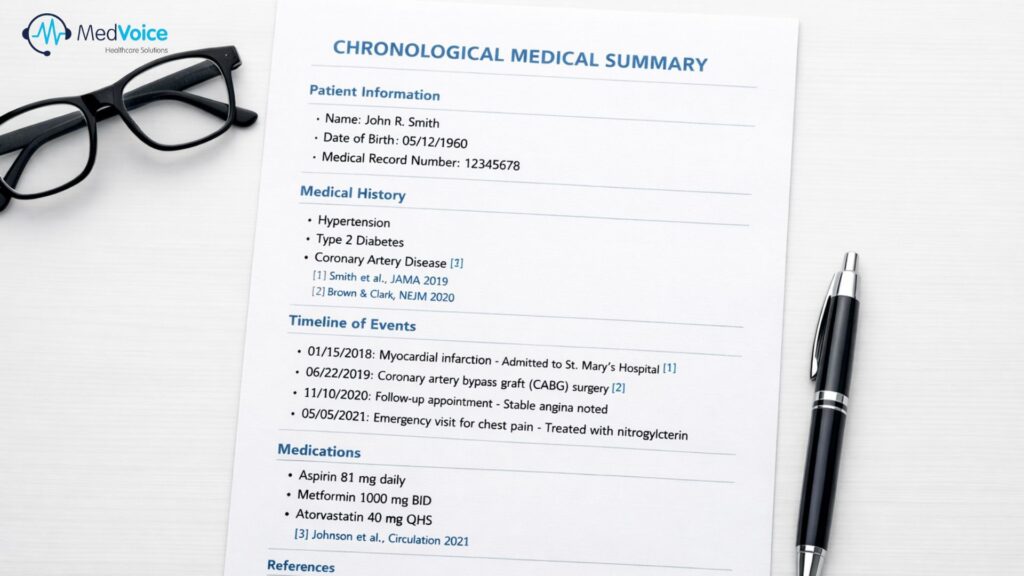
Not all summaries are equally useful. High-quality IME summaries should be:
✔ Accurate and fact-based
✔ Neutral and non-argumentative
✔ Comprehensive yet concise
✔ Clearly structured
✔ Easy to navigate
✔ Supported by source citations
✔ Written in professional medical language
Poorly prepared summaries can introduce bias or omit critical details, potentially undermining the entire evaluation.
The Growing Need for Professional Medical Summarization
As IME cases become more complex and documentation volumes increase, professional summarization services are becoming essential rather than optional. Specialized medical documentation experts combine clinical understanding with legal awareness to produce summaries that meet the needs of both medical and legal professionals.
For organizations handling large caseloads, outsourcing chronological summaries through healthcare BPO solutions offers:
- Faster turnaround times
- Consistent quality
- Scalable support
- Reduced administrative burden
- Enhanced accuracy
Conclusion

In IME cases, decisions with significant financial, legal, and personal consequences often depend on how well medical histories are understood. Chronological medical summaries bring order to chaos. They illuminate patterns, clarify causation, expose inconsistencies, and support objective decision-making. Without them, critical insights may remain hidden within thousands of pages of unstructured records. With them, IME professionals gain a clear, reliable foundation for fair and defensible evaluations.
At MedVoice, we understand that precision in medical documentation is not just about efficiency — it’s about enabling better outcomes. High-quality chronological medical summaries empower IME physicians and legal teams to focus on what matters most: evidence-based decisions.